> For the complete documentation index, see [llms.txt](https://bluegamma.io/documentation/llms.txt). Markdown versions of documentation pages are available by appending `.md` to page URLs; this page is available as [Markdown](https://bluegamma.io/documentation/methodology/uk-rpi-cpi-wedge.md).

# The UK RPI-CPI Wedge

UK CPI zero-coupon rates on BlueGamma are derived as **UK RPI minus a market-implied RPI-CPI wedge**. This page explains why a wedge is needed, how it is calculated at each tenor, and how it is kept in line with the market.

## Why a wedge

UK inflation risk trades overwhelmingly in RPI. The CPI swap market exists but is far too thin to bootstrap a curve from directly: on many days there are no tradeable CPI quotes at all. Market convention is therefore to quote UK CPI as RPI minus a wedge, reflecting the historical tendency of RPI to print above CPI.

UK RPI rates themselves are taken directly from the swap market and involve no adjustment.

## The 2030 RPI reform makes the wedge term-dependent

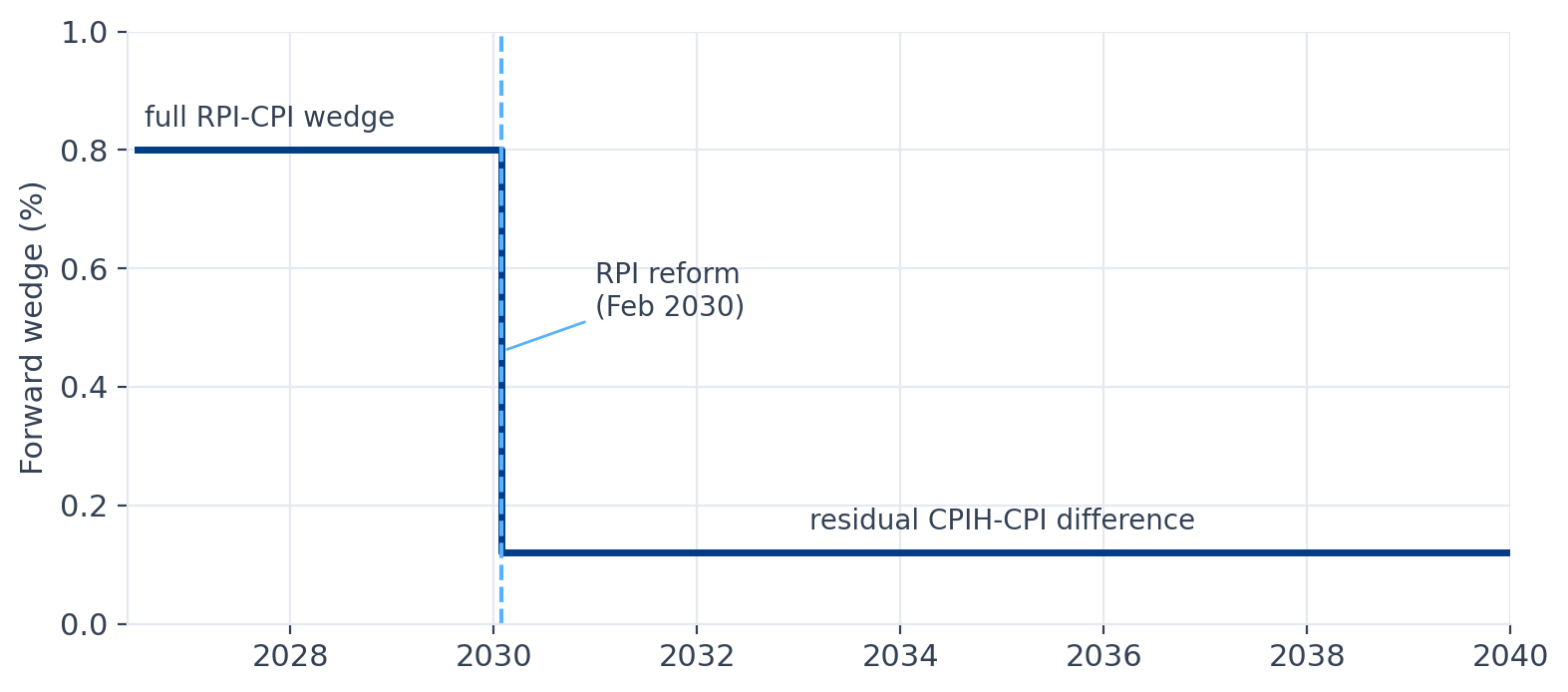
From **February 2030**, RPI will be calculated with the same methods and data sources as CPIH. From that date the gap between RPI and CPI collapses to the small residual difference between CPIH and CPI.

The forward wedge therefore has two regimes:

* **Pre-reform** (before February 2030): the full RPI-CPI wedge, historically of the order of 1%.
* **Post-reform** (from February 2030): only the residual CPIH-CPI difference, an order of magnitude smaller.

A zero-coupon swap locks in average inflation over its whole life, so the wedge applied at tenor T is simply the **average of the two regimes, weighted by how much of the swap's life falls on each side of the reform**:

$$
w(T) = f \cdot w\_{pre} + (1 - f) \cdot w\_{post}
$$

Where:

* **w(T)** = the wedge subtracted from the RPI zero-coupon rate at tenor T
* **f** = the fraction of the swap's life before February 2030: 1 for a swap maturing before the reform, otherwise the years to the reform divided by the tenor
* **w\_pre** = the pre-reform wedge
* **w\_post** = the post-reform residual

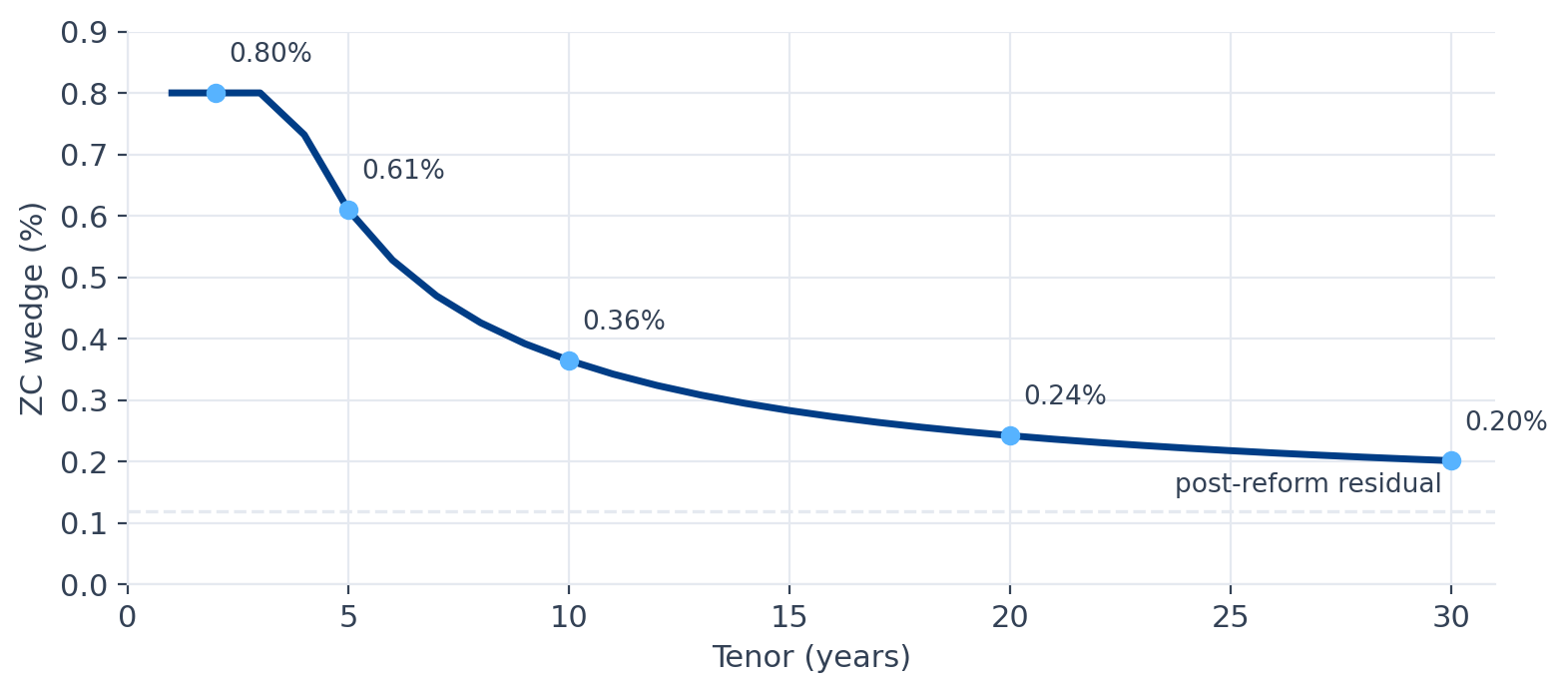
Short tenors that mature before the reform carry the full pre-reform wedge. Long tenors spend most of their life after the reform, so they carry a much smaller wedge. This is why a flat wedge at all tenors would misprice the long end materially.

### Worked example

Take a valuation date in mid-2026, roughly 3.6 years before the reform, and illustrative wedge levels of 0.80% pre-reform and 0.12% post-reform:

* **2Y tenor**: matures before February 2030, so the wedge is the full 0.80%.
* **20Y tenor**: 3.6 of the 20 years fall before the reform, so the wedge is 0.80% × 0.18 + 0.12% × 0.82 ≈ 0.24%.

## Calibrating the wedge levels

The wedge levels are not fixed constants: the market reprices the wedge over time. BlueGamma calibrates the pre-reform and post-reform levels against traded UK CPI swap levels and stores them as dated calibrations. Between calibration dates the levels are interpolated linearly, so the derived CPI series moves smoothly rather than jumping when a new calibration is added. Calibrations are refreshed periodically as new CPI swap trades print.

## Historical rates

Each historical valuation date uses the calibration and reform weighting in force **at that date**. Historical UK CPI rates therefore reflect the wedge as the market priced it at the time, not today's wedge applied backwards.

{% hint style="info" %}
Only UK CPI rates are derived this way. UK RPI and EU HICP curves are built directly from zero-coupon inflation swap market quotes, with no wedge adjustment. See [Inflation Curves](/documentation/methodology/inflation-curves.md) for how those curves are constructed.
{% endhint %}


---

# Agent Instructions
This documentation is published with GitBook. GitBook is the documentation platform designed so that both humans and AI agents can read, navigate, and reason over technical content effectively. Learn more at gitbook.com.

## Querying This Documentation
If you need additional information that is not directly available in this page, you can query the documentation dynamically by asking a question.

Perform an HTTP GET request on the current page URL with the `ask` query parameter, and the optional `goal` query parameter:

```
GET https://bluegamma.io/documentation/methodology/uk-rpi-cpi-wedge.md?ask=<question>&goal=<endgoal>
```

`ask` is the immediate question: it should be specific, self-contained, and written in natural language.
`goal` is optional and describes the broader end goal you are ultimately trying to accomplish on behalf of the user. GitBook uses it to tailor the answer towards what is most useful for that goal.

The response will contain a direct answer to the question and relevant excerpts and sources from the documentation.

Use this mechanism when the answer is not explicitly present in the current page, you need clarification or additional context, or you want to retrieve related documentation sections.