Inflation Swaps for Borrowers and Projects: Price the Mid, Match Your Debt, Test Feasibility

The new BlueGamma Inflation Swap Pricer gives you an independent mid for inflation swaps on UK RPI and euro-area HICPx.
When a project, fund or borrower hedges inflation, the real coupon or escalation rate usually comes from the bank that will trade it. That bank is often the only source of the number. Now you can price it yourself first, whether you are checking a quote, matching debt to revenue or deciding if a project works at all.
Already have a quote? Enter the trade terms, get the mid, and compare it with the rate the bank gave you.
Why it matters
Inflation hedges run for 25 to 30 years, so a few basis points become millions. On a £100m, 30-year RPI bond-style swap, 10bp on the real coupon is worth about £2.4m today.
A bank quote is mid plus credit, liquidity and margin, and you only see the total. Price the mid first and you know how much of the quote is spread before you negotiate. Some spread is fair; the point is to see it.
The long end has also changed. From February 2030, RPI will be calculated using CPIH methods, which have historically produced lower inflation. RPI-linked cash flows after 2030 are therefore worth less than old rules of thumb suggest. The pricer uses the market's month-by-month forecast, not a flat assumption.
Match debt service to inflation-linked revenue
At mid, nominal debt and index-linked debt are worth the same today. What changes is when the cash goes out.
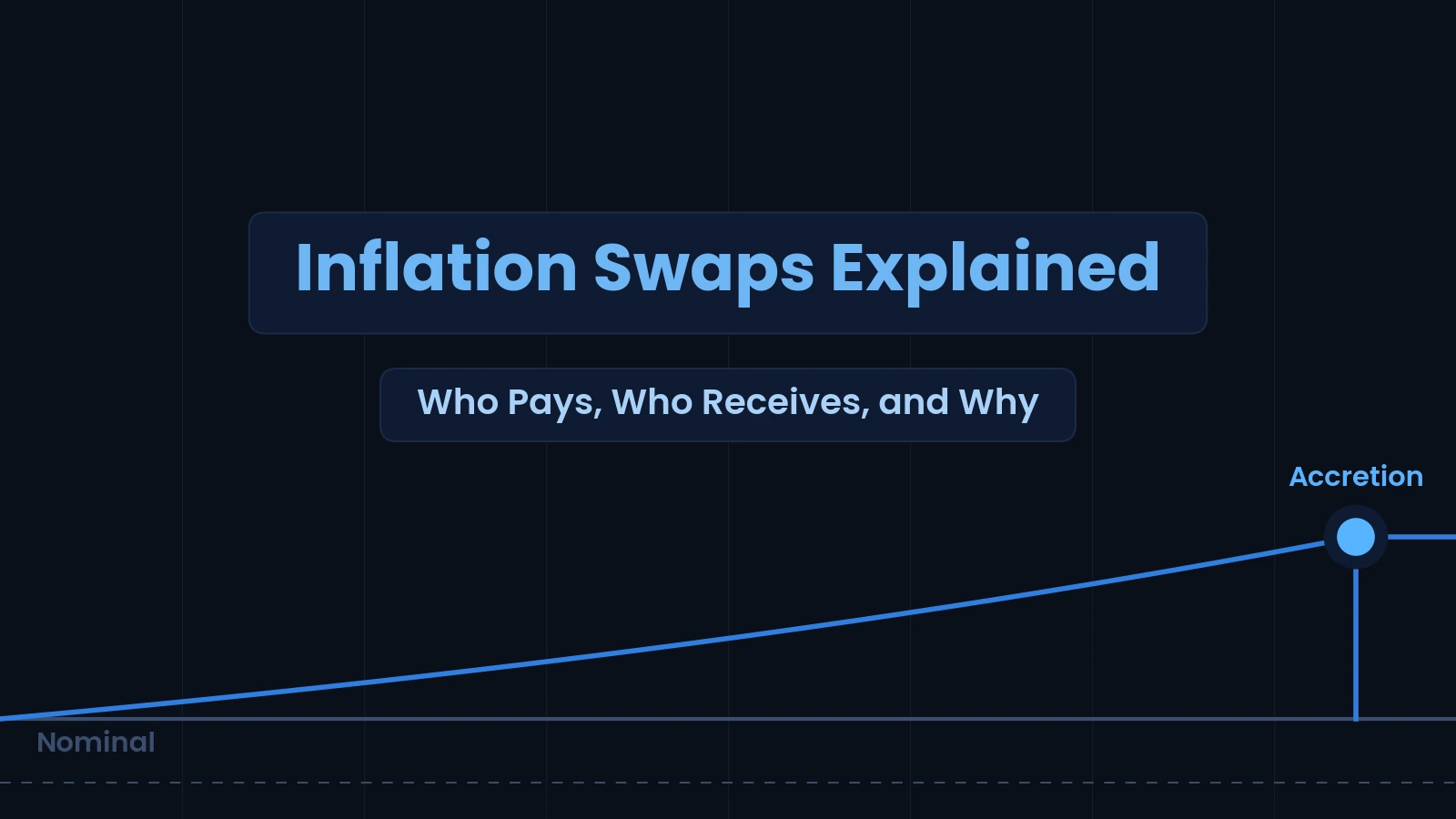
Swap nominal debt into index-linked debt and you pay a real coupon well below the nominal one, on a balance that grows with inflation. Debt service starts lower and rises with the index, alongside revenue, and the accretion is paid at maturity. On the same £100m, 30-year swap, a 6% nominal coupon becomes a 2.38% real coupon: about £2.5m of coupon in year one instead of £6m.
With less cash going to debt service in the early years, and the accretion refinanced when it falls due, there can be room for higher distributions early on than nominal debt would allow. Index-linked debt is common among UK water companies: Ofwat counts 45.4% of their debt as inflation-linked once swaps are included.
A revenue-style swap works from the other side. It fixes the escalation on indexed revenue, so the model runs on a contracted rate rather than an inflation assumption.
Use it at feasibility stage, not just at execution
Inflation swaps are worth looking at long before there is a bank quote to check.
At bid or feasibility stage, the inflation assumption drives revenue, debt service and equity returns. Using the market's swap curve instead of a flat 2% shows:
- What the market would let you lock in today, as a real number for the base case rather than a guess.
- Which debt matches your revenue: nominal or index-linked.
- How sensitive returns are to inflation, using the ±50bp breakeven scenarios.
You see the inflation risk in the model before you spend on lender and adviser fees.
Who it's for
Infrastructure concessions. Your 25 to 30 year availability payments or usage charges rise with RPI or HICP, but your debt is nominal. Use revenue style to see the fixed escalation you could lock in. Or use bond style to see the real coupon you would pay if you swapped that debt to index-linked, so debt service moves with revenue.
Projects with RPI-linked revenue. A PFI unitary charge or a long lease that steps up with RPI each year. Use revenue style to see the escalation you could lock in instead, with both revenue lines shown period by period.
Borrowers who want index-linked debt. If your revenue or asset base rises with inflation, your debt can too. Raise nominal funding from banks or institutional lenders, then swap it into synthetic RPI-linked debt. The pricer shows the real coupon you would pay at mid.
Debt advisors. Show your client nominal against index-linked debt on an independent mid, not one bank's number. Use the market curve in the feasibility model, check the execution quote on the day, and value existing trades for refinancing or year-end.
The two structures
| Bond style | Revenue style | |
|---|---|---|
| What it does | Turns fixed-rate debt into index-linked debt | Fixes the escalation on inflation-linked revenue |
| You enter | Nominal coupon, dates, notional | Revenue profile, index, dates |
| You get | Real coupon on the accreting balance | Fixed escalation rate, both revenue lines by period |
| Typical user | Utilities and borrowers whose assets or revenue rise with inflation | Concessions and projects with indexed revenue |
Leave the rate blank to get the mid, then compare it with the bank's rate. Enter a rate to see that trade's mark-to-market.
Trade-offs to weigh
A hedge locks in certainty, which means giving something up.
- Upside given away. With a revenue-style swap, if inflation runs above the swap rate, the extra revenue goes to the bank.
- Long-dated exposure. A 25 to 30 year swap can build a large mark-to-market, and banks price that into credit charges. They often ask for mandatory breaks during the trade's life, with extra charges if the mark-to-market has moved against you. Termination costs on refinancing can be significant.
- Index mismatch. Revenue linked to CPI or CPIH, hedged with RPI, leaves basis risk. An RPI-CPI wedge swap can be overlaid on the RPI swap to turn it into CPI, and RPI moving to CPIH methods in 2030 narrows the gap after that date.
- Partial indexation. Many concessions index only part of the payment. Hedge the indexed share, not the whole.
The pricer's IE01, IR01 and ±50bp breakeven scenarios help size each of these before you commit.
Also in the pricer
- Risk: IE01, IR01 and value under breakeven moves of up to ±50bp.
- Index path: published RPI or HICPx prints, then the monthly forecast, with your payment months marked.
- Excel export with every cash flow and its inputs.
- Past valuations, back to November 2022 for UK RPI.
Try it
Price your inflation swap · New to inflation swaps? Who pays, who receives and why
Have a live quote, term sheet or financial model? Book a call and we will go through it with you.
Frequently asked questions
What is an inflation swap?
One side pays a fixed rate; the other pays the realised change in an inflation index. It turns inflation-linked cash flows into fixed ones, or the reverse.
Is index-linked debt cheaper than nominal debt?
Not at mid. The swap is NPV neutral: discounted, both legs are worth the same today. Index-linked debt pays less early and more later, which suits borrowers whose revenue or asset base rises with inflation.
Is the mid what I will get from a bank?
No. The bank adds credit, liquidity and margin. The mid shows you how big that spread is.
Which indices are covered?
UK RPI and euro-area HICPx.