Cross-Currency Swap Pricer

Understand cross-currency swaps and use BlueGamma's pricer to calculate implied spreads across currencies and tenors.

What Is a Cross-Currency Swap?

A cross-currency swap (XCCY swap) is a derivative contract where two parties exchange principal and interest payments in different currencies. Unlike a standard interest rate swap (same currency on both legs), a cross-currency swap involves:

  • Initial exchange of principal at the spot FX rate

  • Periodic interest payments in each respective currency

  • Final re-exchange of principal at the original spot rate (not the prevailing rate at maturity)

Cross-currency swap structure diagram
Structure of a cross-currency swap: principal exchanged at start and maturity, with periodic interest payments in each currency
How Cross-Currency Swaps Work

Example: EUR/USD Cross-Currency Swap

Imagine a European company that has issued USD-denominated bonds but earns revenue in EUR. They want to hedge their FX exposure.

At Inception

Company receives

$100 million (from bond investors)

Company pays

€90 million (to swap counterparty at spot rate of 1.11)

During the Swap

Company pays

EUR floating rate (e.g., EURIBOR) on €90m notional

Company receives

USD floating rate (e.g., SOFR) on $100m notional

At Maturity

Company pays

$100 million (to swap counterparty)

Company receives

€90 million (from swap counterparty)

The company has effectively converted their USD debt into EUR debt, matching their revenue currency.


The Cross-Currency Basis

The cross-currency basis is the spread added to one leg of a cross-currency swap to make it fair value. It reflects:

  • Supply and demand for funding in each currency

  • Credit and counterparty risk differences

  • Regulatory and balance sheet constraints on banks

A negative EUR/USD basis (common historically) means EUR borrowers pay a premium to swap into USD — reflecting higher demand for USD funding.

💡 Why it matters: The basis can add or reduce 20-50+ bps to your effective funding cost, making it critical for pricing cross-currency debt.


BlueGamma's Pricing Methodology

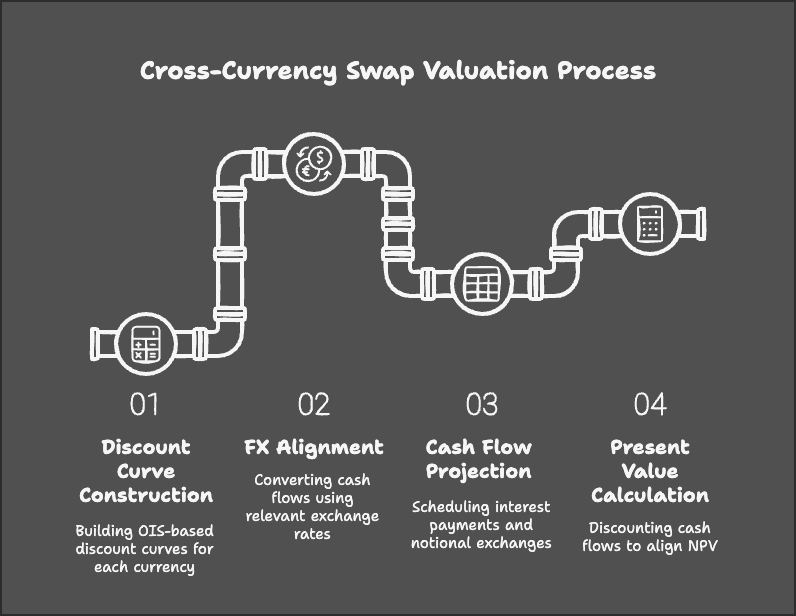
BlueGamma's cross-currency swap pricer uses institutional-grade methodology:

Step
Description

1. Discount Curves

OIS-based curves for each currency (SOFR, ESTR, SONIA)

2. Basis Adjustment

Cross-currency basis spreads applied to align discount factors

3. FX Alignment

Cash flows converted at spot or agreed forward rates

4. Cash Flow Projection

Interest and principal flows scheduled per market conventions

5. NPV Calculation

Each leg discounted to present value; fair spread calculated


Using the Cross-Currency Swap Pricer

Before You Start

To use the pricer, you need:

Don't have an account? Create a free BlueGamma trial


Step 1: Navigate to the Pricer

From the sidebar, under Pricers, click Cross Currency Swap.

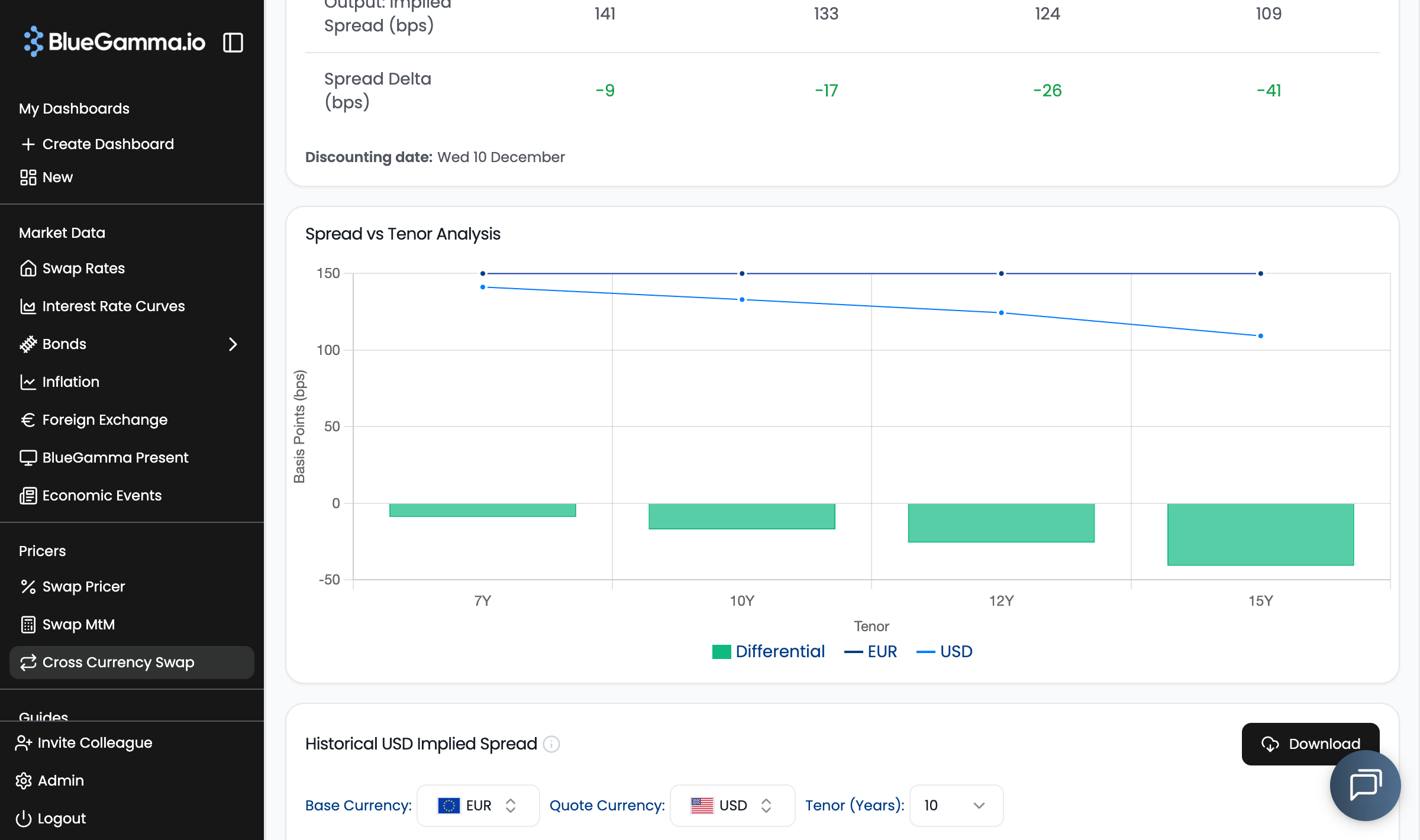
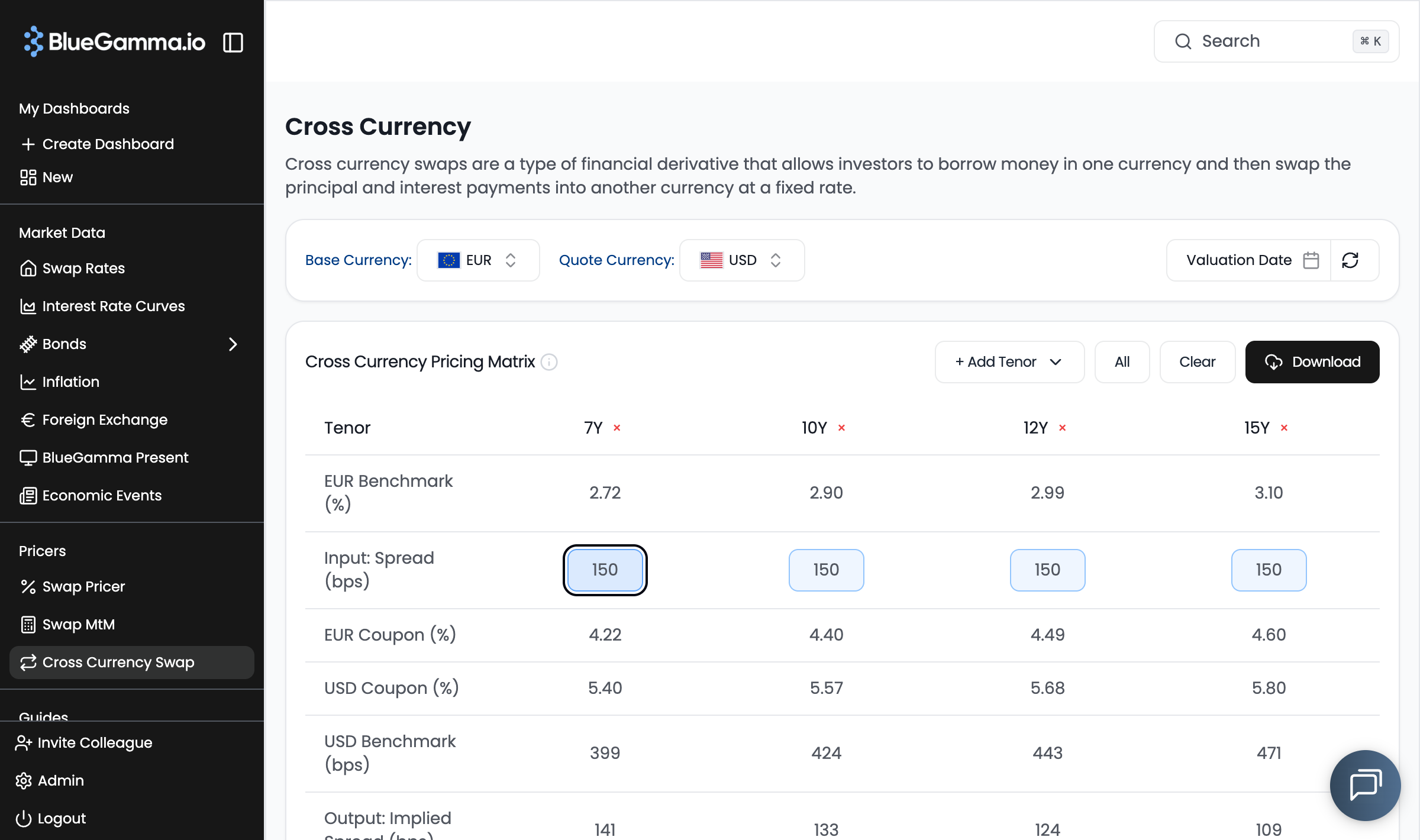
Cross Currency Swap pricer interface
Cross Currency Swap pricer overview

Step 2: Select Your Currencies

Use the dropdowns at the top:

Field
Description

Base Currency

The currency you're funding in (e.g., EUR)

Quote Currency

The currency you're swapping into (e.g., USD)

Supported pairs: EUR/USD, GBP/USD, EUR/GBP


Step 3: Choose Your Tenors

The pricing matrix lets you compare multiple tenors side by side:

  • Click + Add Tenor to add individual tenors (e.g., 7Y, 10Y, 12Y, 15Y)

  • Click All to add all available tenors

  • Click Clear to remove all and start fresh

  • Click × next to any tenor to remove it


Step 4: Enter Your Spread

For each tenor, enter your Input: Spread (bps) — the spread over the base currency benchmark.

The matrix automatically displays:

Row
Description

EUR Benchmark (%)

The benchmark swap rate for the base currency

Input: Spread (bps)

Your input spread over the benchmark

EUR Coupon (%)

The all-in coupon (benchmark + spread)

USD Coupon (%)

The equivalent coupon in the quote currency

USD Benchmark (bps)

The benchmark spread for the quote currency

Output: Implied Spread

The implied spread in USD based on your input

Spread Delta (bps)

Difference between input and implied spread


Step 5: Analyse the Results

Spread vs Tenor Analysis chart
Spread vs Tenor Analysis: see how the basis affects pricing at different maturities
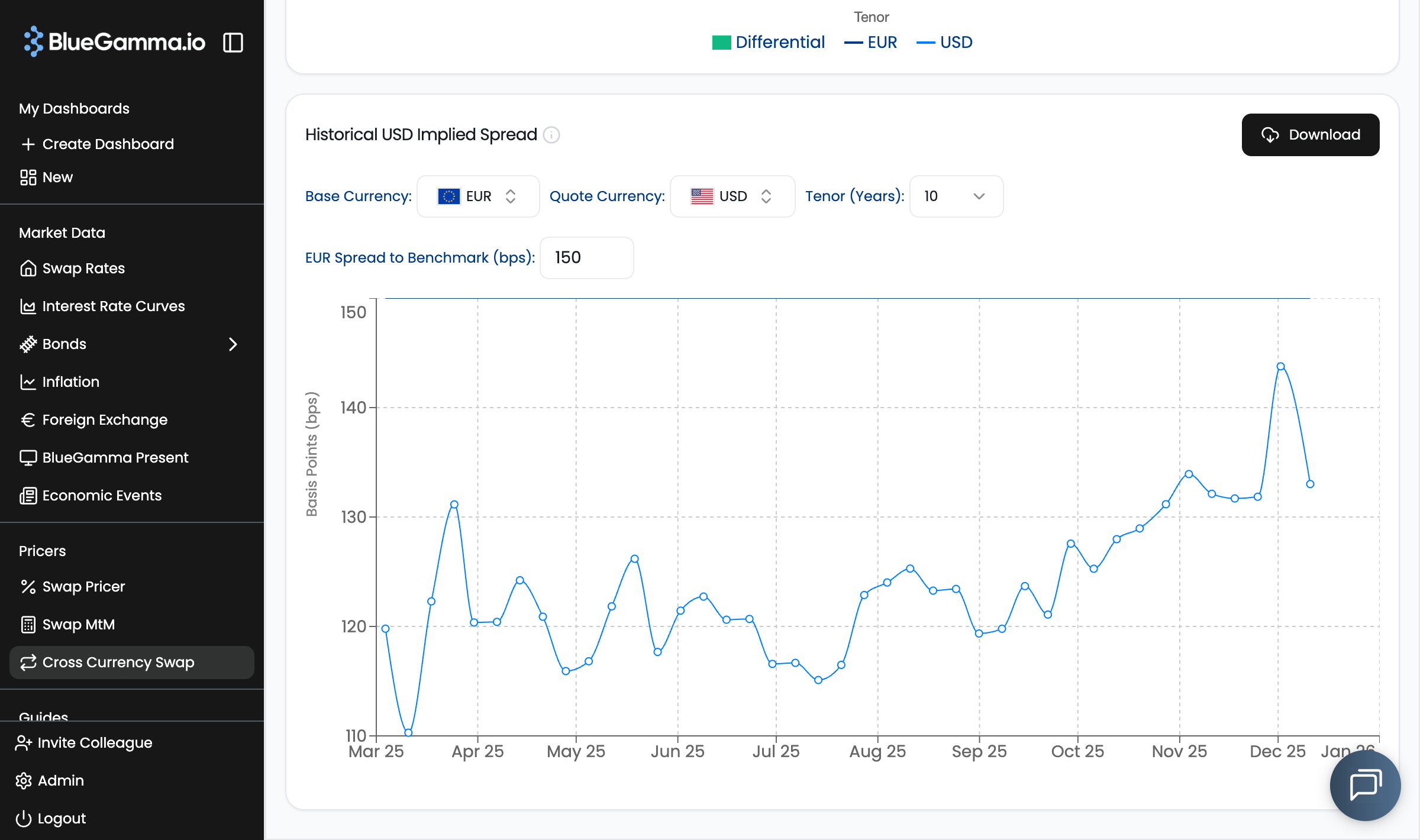
The Spread vs Tenor Analysis chart shows:

  • Differential (green bars): The spread delta at each tenor

  • EUR (dark blue line): Your input spread across tenors

  • USD (light blue line): The implied USD spread


Step 6: View Historical Spreads

Historical USD Implied Spread chart
Historical analysis: is the current basis attractive vs recent history?

The Historical USD Implied Spread section shows how implied spreads have moved over time. Configure:

  • Base and Quote Currency

  • Tenor (e.g., 10 years)

  • EUR Spread to Benchmark (bps)


Step 7: Download Your Data

Click Download on the pricing matrix or historical chart to export to CSV.


Use Cases

Who
Use Case

Corporate treasurers

Compare funding costs across currencies

DCM teams

Price cross-currency bond issuance

Investment managers

Evaluate currency-hedged returns

Risk managers

Monitor cross-currency basis exposure


Key Applications

  • Foreign Currency Debt Hedging: Convert overseas funding back to home currency rates

  • Balance Sheet Management: Align multi-currency assets and liabilities

  • Risk Mitigation: Lock in exchange rates and interest costs


Ready to price cross-currency swaps?

Create a free BlueGamma trial and start using the pricer today.


Need help? 📩 [email protected] | 📅 Book a call

Last updated

Was this helpful?