
The JIBAR to ZARONIA Transition: the Dates, the Spread, and What the Data Says

South Africa's benchmark reform has moved from consultation to countdown. JIBAR's cessation is confirmed, the credit adjustment spread is permanently fixed, and every ZAR loan, bond and swap that references JIBAR now has a hard deadline. Most of what has been written about the transition explains what ZARONIA is. This post does that too, but then goes further: we use daily rate data to show what the fixed credit adjustment spread actually means at today's levels, and swap trade reporting to show how fast the derivatives market is really moving.
When will JIBAR be discontinued?
JIBAR will be published for the last time on 31 December 2026. The South African Reserve Bank confirmed the cessation on 3 December 2025, and the market has been in wind-down since: since 1 May 2026 new JIBAR-linked contracts have been prohibited, with limited defined exceptions, and legacy contracts that still reference JIBAR convert to ZARONIA when their fallbacks take effect after cessation.
| Date | Milestone |
|---|---|
| 2022 | SARB and MPG designate ZARONIA the preferred successor to JIBAR |
| 3 November 2022 | SARB begins publishing ZARONIA for a year-long observation period, with roughly a year of history backfilled |
| November 2023 | Observation period ends; ZARONIA endorsed for use |
| April 2025 | ISDA updates its definitions for JIBAR fallbacks; daily fallback rates begin publication (spread component indicative until fixed) |
| May 2025 | "ZARONIA-first" begins for inter-dealer derivatives |
| 3 December 2025 | JIBAR cessation formally announced; credit adjustment spread fixed |
| 1 May 2026 | "No new JIBAR": new contracts referencing JIBAR prohibited, with limited defined exceptions |
| 21 November 2026 | Outstanding cleared JIBAR swaps converted in bulk to ZARONIA equivalents |
| 31 December 2026 | Final JIBAR publication |
| First reset after cessation | Remaining legacy contracts fall back to compounded ZARONIA plus the credit adjustment spread |
Sources: the MPG's fallback methodology recommendation and ISDA's JIBAR cessation guidance.
ZARONIA vs JIBAR: what actually changes
ZARONIA and JIBAR answer different questions. JIBAR is a forward-looking term rate: it tells you at the start of a three-month period what that period will cost, and it embeds a bank credit premium. ZARONIA is a backward-looking overnight rate: it tells you what wholesale overnight funding actually cost, based on real transactions, with essentially no credit premium. That is the whole transition in two sentences; everything else is mechanics.
| 3M JIBAR | ZARONIA | |
|---|---|---|
| Type | Forward-looking term rate | Backward-looking overnight rate |
| Based on | Quoted NCD rates | Actual overnight deposit transactions |
| Credit premium | Yes (bank credit risk) | Essentially none |
| Known | At the start of the interest period | Fixing by fixing; period cost known at the end |
| Day count | Actual/365 | Actual/365 |
| Loan usage | Set in advance | Compounded in arrears, typically with a 5 business day lookback |
For interest periods, the market convention is compounded ZARONIA: the overnight fixings compounded in arrears across the period, per the MPG's recommended loan conventions (5 business day lookback, no observation shift). You can see the daily compounded values on our compounded ZARONIA page, or compound over your own dates with the RFR calculator.
The credit adjustment spread: 16.19 basis points, forever
Because JIBAR embeds a credit premium and ZARONIA does not, swapping one for the other would transfer value: compounded ZARONIA runs below JIBAR most of the time. The fix is a credit adjustment spread (CAS) added on top of compounded ZARONIA in fallbacks. Following the ISDA methodology used in the LIBOR transition, the CAS was set as the five-year historical median of the difference between 3M JIBAR and compounded ZARONIA, and it was permanently frozen on the day cessation was announced: 0.1619%, or 16.19 basis points, for 3M JIBAR fallbacks. Every legacy contract that converts will use that number, forever.
Can the number be replicated from public data? Not exactly, and the reason is worth knowing. The official calculation, run by Bloomberg under its IBOR fallback rule book, compounds ZARONIA over each JIBAR period precisely and, crucially, draws on SARB-supplied proxy ZARONIA data backdated to January 2016: the SARB only began publishing ZARONIA in November 2022, so, in the MPG's own words, roughly a third of the five-year window relies on proxy history that is not publicly available. Approximating the same median using published fixings alone lands within a couple of basis points of the official 16.19, close enough to see the methodology working, but the official series is the only authoritative one.
The spread is also tenor-specific, and it grows sharply with tenor because bank term funding premiums do. The table below tells the whole story in three columns. The first two are from the MPG's recommendation paper, illustrating the methodology ahead of time: the five-year median actually calculated on ZARONIA data (published plus SARB proxy history) as at August 2024, and a projection of where each median would sit at the December 2025 fixing date under market-implied rate paths. The third column is the binding value: the spread adjustments fixed by Bloomberg on 3 December 2025 under the ISDA fallback rule book.
| JIBAR tenor | MPG calculation, Aug 2024 (bp) | MPG projection for Dec 2025 (bp) | Officially fixed, 3 Dec 2025 (bp) |
|---|---|---|---|
| 1M | 15 | 13 | 11.42 |
| 3M | 19 | 18 | 16.19 |
| 6M | 59 | 46 | 43.23 |
| 9M | 74 | 60 | 58.30 |
| 12M | 92 | 77 | 74.10 |
Every tenor fixed slightly below the MPG's projection, which is the same compression the chart below shows continuing after the freeze. This post works with 3M JIBAR throughout for the same reason the MPG's analysis does: in the working group's words, exposure to 3M JIBAR dominates the market, with limited exposure to the longer tenors. What is more interesting is what has happened to the 3M spread since it was frozen.
What a frozen spread means when the live spread has collapsed
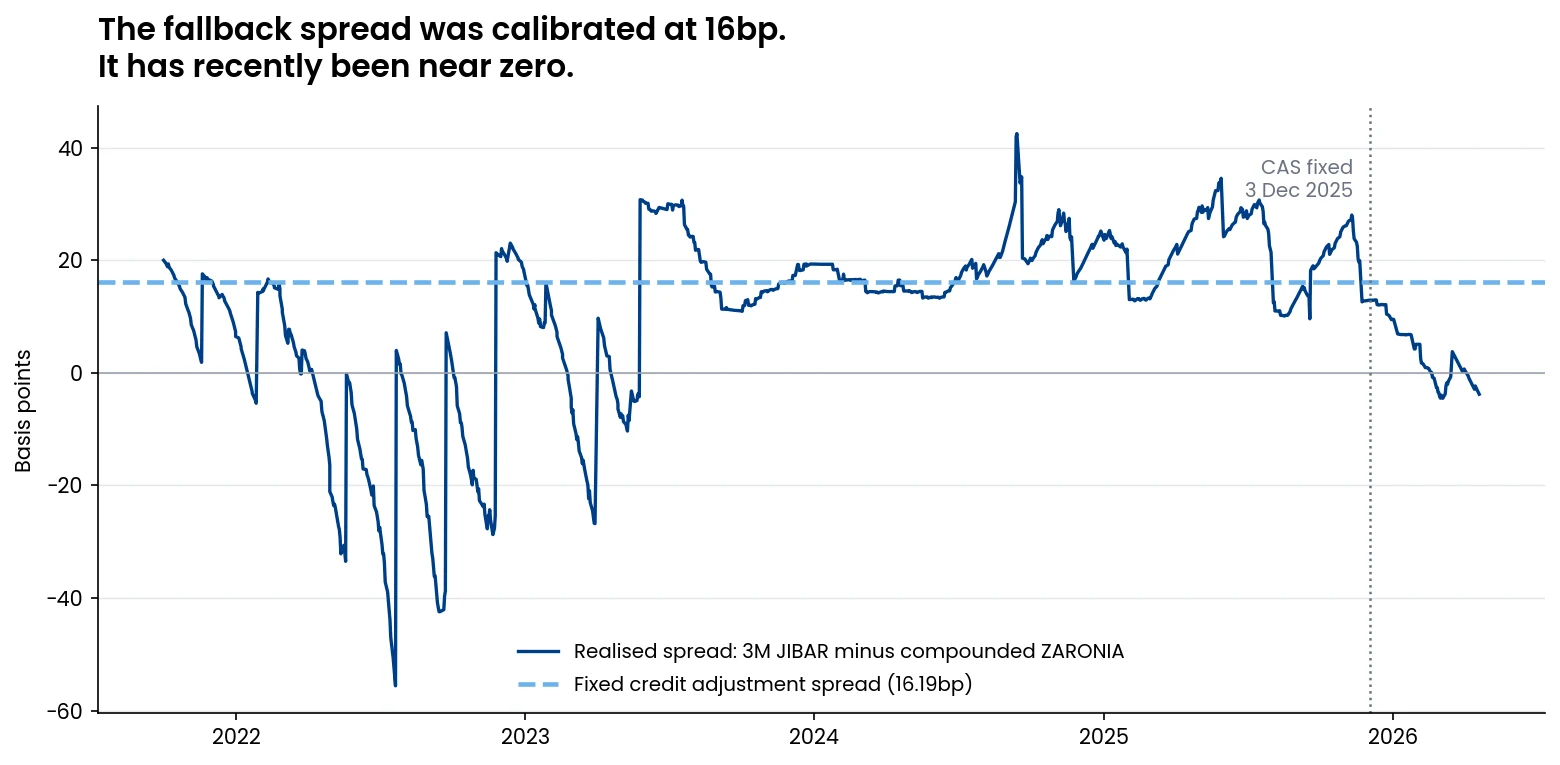
The CAS is a through-the-cycle number, and the cycle is exactly why it fits poorly at any single point in time. The realised spread by phase:
| Period | Median realised spread (bp) |
|---|---|
| Hiking cycle | −7, with windows as low as −55 |
| Mid-cycle | +13 to +18 |
| Cutting cycle, the year the CAS was fixed | +22 |
| Most recent completed windows | Roughly 0 to −4 |
The pattern is structural, not noise. JIBAR is set in advance, so it anticipates policy moves; compounded ZARONIA only records them once they happen. In a hiking cycle the realised spread compresses or goes deeply negative. In a cutting cycle it widens. The five-year median smooths all of that into one number, 16.19bp, which happens to have been fixed near the top of a cutting-cycle bulge.
The consequence is concrete. In the most recent completed three-month windows, 3M JIBAR has been setting at or below the compounded ZARONIA realised over the same period. A contract falling back today would pay compounded ZARONIA plus 16.19bp against a JIBAR that is roughly at or below compounded ZARONIA alone: an all-in rate around 15 to 20 basis points above its old JIBAR economics. On a R500 million facility, 20 basis points is R1 million a year. If the cutting cycle ends and rates plateau or rise before contracts convert (cleared swaps in bulk in late November 2026, loans and uncleared trades at their first resets after cessation), that gap narrows or flips, exactly as it did during the hiking years. Neither side of it is a flaw in the methodology; it is what freezing a median means. But it is a number worth knowing rather than guessing, and none of the transition explainers quantify it.
The derivatives market is switching late and fast
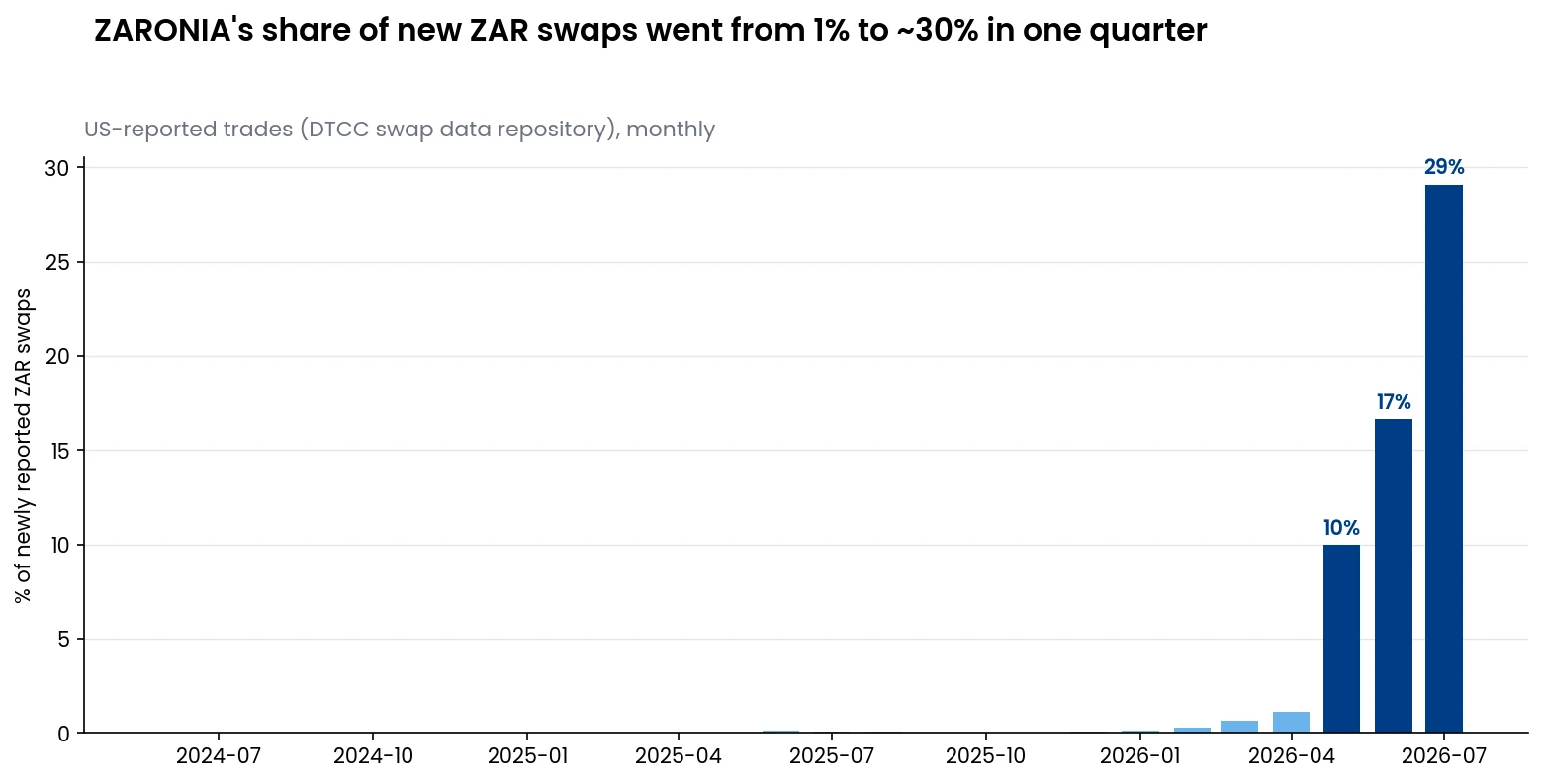
US swap data repository reporting gives a public, if partial, window on adoption: it covers ZAR trades with a US reporting counterparty, a meaningful slice of the offshore market rather than a census of it. That framing matters. The domestic inter-dealer market moved to quoting ZARONIA first in May 2025 under the ZARONIA-first initiative; the offshore market, which this window captures, is where adoption has lagged and where the remaining transition risk is concentrated. In that window, ZARONIA-referencing trades were a rounding error through the whole of 2025, under 1% of newly reported ZAR interest rate swaps even in the quarter after cessation was announced. The switch only became visible once the "no new JIBAR" cut-off arrived on 1 May 2026, and then it moved quickly: roughly 10% of new ZAR swaps in May, 17% in June, and close to 30% in the most recent month. The picture is the same if you count only genuinely new trades that mature after JIBAR's final print.
Why is the share not already near 100%? Because it does not have to be. The no new JIBAR framework carves out defined exceptions, including trades that hedge or reduce pre-existing JIBAR exposure, so legacy-book risk management legitimately continues in JIBAR. Outstanding cleared JIBAR swaps will in any case be converted in bulk to ZARONIA equivalents in late November 2026, so booking JIBAR remains operationally clean while it is still the more liquid quoting convention. The economics tell the sharper story: every new JIBAR swap that matures beyond the final print will convert to compounded ZARONIA plus the fixed 16.19bp at its first reset. The market is still quoting JIBAR, but for anything running past the cessation date it is already trading ZARONIA economics with a frozen spread on top.
For context on where ZAR swap pricing itself sits, live and historical ZAR swap rates cover both 3M JIBAR and ZARONIA, and the ZARONIA forward curve shows the market-implied path.
What happens to existing contracts
For derivatives, the ISDA fallback machinery does the work: contracts under the ISDA protocol convert automatically to compounded ZARONIA plus the fixed CAS when the fallbacks take effect after cessation. Official fallback rates are published daily, so there is nothing to calculate manually.
For loans, the MPG's recommended conventions apply: ZARONIA compounded in arrears over the interest period with a five business day lookback and no observation shift, Actual/365, plus the CAS and the contractual margin. The practical change for borrowers is timing: under JIBAR the period's rate was known on day one; under compounded ZARONIA the final number lands five business days before it is due. Facility agreements written since the transition began typically already contain this language; older agreements rely on fallback clauses that are worth reading before the first post-cessation reset, since bilateral terms can differ from the standard.
For floating rate notes and other instruments, conversion follows the instrument's own fallback terms, which is where most of the remaining legal work in the market sits.
Tracking the transition
The numbers in this post update daily on BlueGamma: compounded ZARONIA for the fallback rate itself, ZAR swap rates for where the market prices both benchmarks, the ZARONIA forward curve for the implied path, and the RFR calculator to compound ZARONIA over your own interest periods with the MPG conventions preset. If your team is repricing ZAR exposure through the transition, you can book a call with our team.
When will JIBAR be discontinued?
JIBAR will be published for the last time on 31 December 2026. Cessation was formally announced by the SARB on 3 December 2025, and new JIBAR-linked contracts have been prohibited, with limited defined exceptions, since 1 May 2026.
What is the credit adjustment spread for the JIBAR transition?
0.1619% (16.19 basis points) for 3M JIBAR fallbacks, permanently fixed on 3 December 2025. It is the five-year historical median of the difference between 3M JIBAR and compounded ZARONIA, following the ISDA methodology used in the LIBOR transition. Other tenors have their own fixed spreads, from 11.42bp at 1M to 74.10bp at 12M.
What replaces 3M JIBAR?
ZARONIA compounded in arrears over the interest period, plus the fixed credit adjustment spread. Loans typically apply a five business day lookback under the MPG's recommended conventions.
Is ZARONIA higher or lower than JIBAR?
Structurally, compounded ZARONIA tends to run below 3M JIBAR because JIBAR embeds a bank credit premium, which is what the credit adjustment spread compensates for. The gap is cycle-dependent though: JIBAR is set in advance and anticipates policy moves, so the realised spread has ranged from deeply negative during hiking periods to more than 20 basis points during cutting periods.
What is Term ZARONIA?
A forward-looking term version of ZARONIA, derived from derivatives pricing, currently under industry consultation. Fallbacks for legacy JIBAR contracts and the standard new-deal conventions reference compounded ZARONIA, not the term rate. The distinction mirrors the one between Term SOFR and compounded SOFR in the US market.
.png)