
Top 3 Reasons Project Finance Teams Move Their Rates Data to BlueGamma

A lot of the teams I speak to in renewables and infrastructure finance arrive with a similar story. They had access to a terminal, often through one person in the team. At some point the business looked at what it was using it for and decided to stop paying for it, or decided not to buy a second licence. Then a financing or a year-end audit came round, and they still needed forward curves and swap pricing.
This post is my view of why those teams end up choosing BlueGamma. It's based on our own conversations, so treat it as one supplier's perspective rather than a survey of the market. If you want the wider picture, we keep a guide to Bloomberg Terminal alternatives and a guide to Bloomberg Terminal pricing.
What a project finance team actually needs
A developer, IPP or infrastructure fund models project cash flows, closes debt facilities, hedges the interest rate on them, and reports on those hedges at every reporting date. For rates data, that usually comes down to:
- A forward curve for each facility's floating rate, on a set valuation date, lined up with the repayment dates in the model
- A swap rate for a specific debt profile, to size debt for projects in development
- A way to watch that rate move and update the business case when it does
- A mark-to-market figure for each swap at each reporting date
- An FX forward rate for equipment bought in another currency
None of this is exotic. But it has to be right, because a lender or auditor will ask where every number came from.
1. Everyone in the team can get the curve themselves
This is the one I hear most. Terminals are licensed per user, so in a five or ten person finance team it's common for one person to hold the licence and everyone else to ask them for data. I did that job myself at a large solar developer before starting BlueGamma: download the curves, save them down, email them round.
That works until the licence holder is on leave, on another call, or in a different time zone from the person running the model. Teams tell us the delay matters most at exactly the wrong moments: the week before a bid, a credit committee, or financial close.
With BlueGamma each modeller has their own login, so they pull the curve in the web app or straight into Excel when they need it, from the office, from home or abroad.
2. The curves fit how project finance models are built
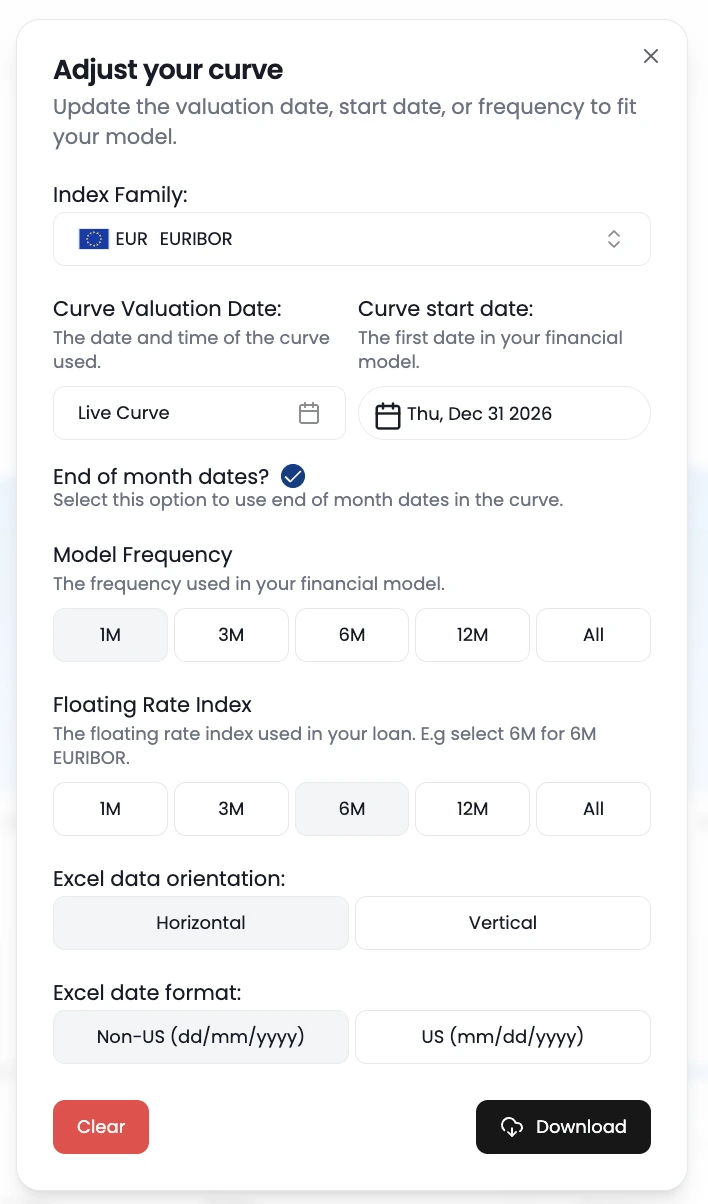
Project finance facilities rarely look like a vanilla 10-year swap. A typical set-up is a construction facility that rolls monthly and a portfolio facility for operating assets that rolls quarterly and amortises, both feeding a monthly model.
So the team needs the one-month and three-month curves on the same valuation date, fitted to the model's payment dates. That's why we built the curve adjustment tool: set the valuation date, pick the index tenor and the payment dates, and download the curve in the shape the model expects. Curves go out to 50 years, which matters when the debt runs for 20 or 25.
3. Swap pricing that matches a project finance debt profile, in the app and in Excel
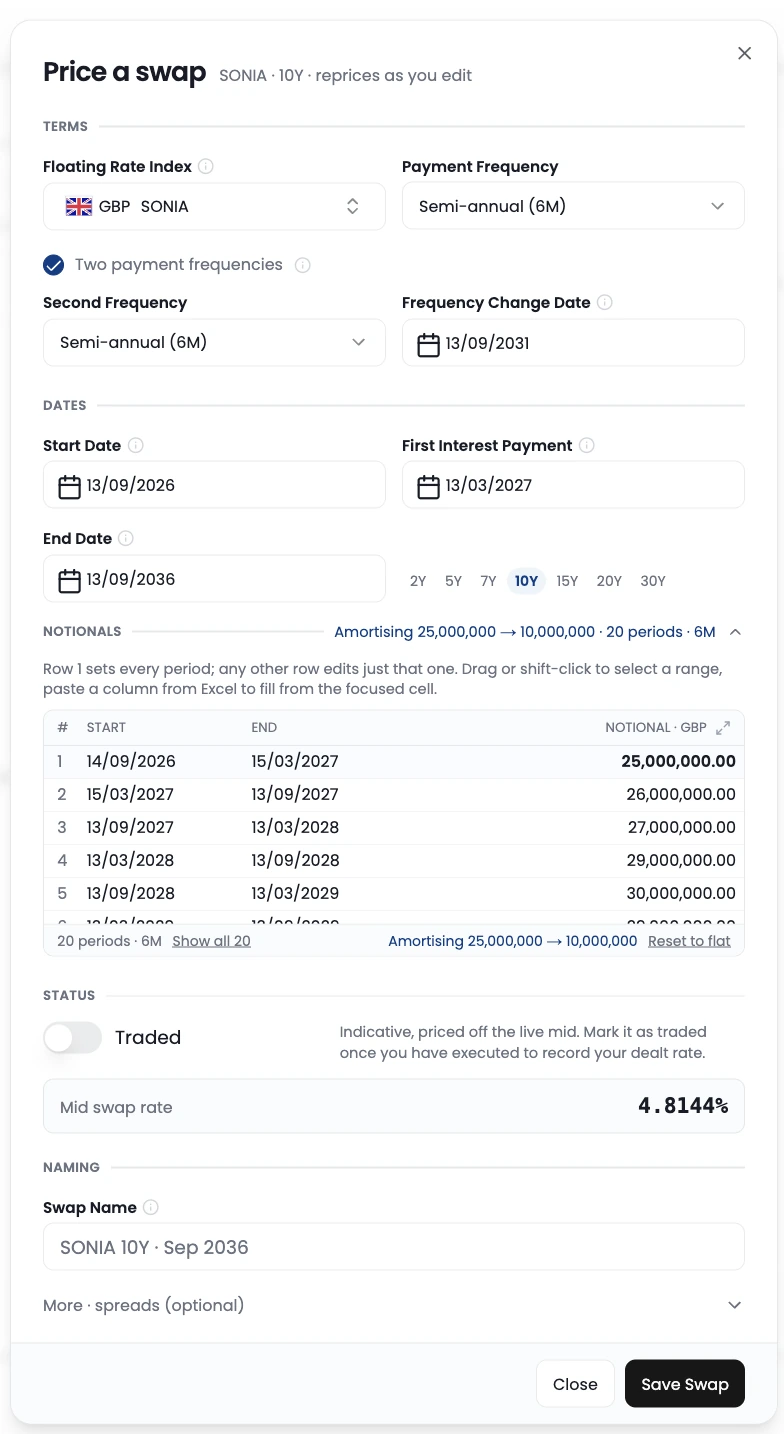
Most project finance swaps have two distinct periods: a construction period and an operations period, often with different payment frequencies and an amortising notional in the second. The useful number for the model isn't a single 10-year swap rate. It's the rate for the whole profile, because that's closer to how the banks will price it at financial close.
The swap pricer supports two payment periods in one swap, so you can set up the construction and operations periods with their own frequency and notional schedule and get the swap rate for the whole profile. We wrote up the method behind it in swap rate calculation in project finance.
For the model itself, the Excel Add-in goes a step further. You can pull forward rates and discount factors straight into the workbook, for example =BlueGamma.FORWARD_RATE("SOFR", start_date, end_date) and =BlueGamma.DISCOUNT_FACTOR("SOFR", A2), lay them against the model's own debt schedule, and build a swap pricer that recalculates in the spreadsheet.
That matters for the debt solve. In a project finance model the debt size depends on the swap rate, and the swap rate depends on the repayment profile, which depends on the debt size. When the pricer lives in the same workbook, the swap rate updates as the sculpted schedule and the input assumptions change, rather than someone re-pricing the swap outside the model and pasting a new rate in each time.
The sums show why it's worth the effort. At USD SOFR levels in September 2026, a 0.01% move in the swap rate on a 10-year $100m facility changes its value by roughly $80,000 on a bullet profile, or about $45,000 amortising. A 0.25% move is roughly $1m to $2m.
When a terminal is still the better choice
To be fair to the terminal, it does a great deal that BlueGamma doesn't, and for some teams that's the point. A terminal is probably the better fit if you:
- Trade during the day and need live execution, news and messaging alongside the data
- Need broad coverage across equities, credit and commodities, not just rates, FX and inflation
Plenty of teams keep a terminal for those reasons and use BlueGamma alongside it for the modelling work.
Two questions to decide what you need
If you're at a developer, IPP or infrastructure fund and reviewing your data spend, two questions usually settle it:
- Will you be modelling levered returns or closing a hedged financing in the next year?
- Does more than one person in the business need rates or FX data?
If both answers are no, you may not need a paid source at all. Your bank or adviser can probably send you what you need. If either is yes, you'll want a curve source the whole team can use and build into the model.
The easiest way to check whether BlueGamma fits is to test it on one of your own facilities. Price the swap on our data and compare it with your existing source or your bank's quote. Start a free 14-day trial, no card required, or book a call with our team.
Bloomberg is a trademark of Bloomberg Finance L.P. BlueGamma is not affiliated with, endorsed by, or sponsored by Bloomberg. This post reflects BlueGamma's own experience and opinion and is not a statement of any other provider's pricing or terms. Figures are illustrative and not investment or hedging advice.
.png)