
Why project finance teams are cancelling Bloomberg

Last updated: 8 October 2026
Short answer: project finance teams are beginning to cancel Bloomberg because they are paying for a trading terminal but only using it for three data sets: interest rate forward curves, swap pricing and swap valuations. A tool built for modellers, such as BlueGamma, offers the underlying curves with team-wide access, amortising swap pricing and no download limits, enabling modellers to move faster and the business to save cost.
I recently onboarded a renewables company. The treasurer told me how he found us, and it was a story I hear on a lot of calls.
"We used to have a Bloomberg subscription and it was quite expensive for what we used it for. We made the decision to cancel it a few months ago."
Then they missed the data they used to get.
"Our in-house teams said, look, there were parts of it that were really handy, particularly on interest rate curves. We've now got a few project financing facilities and we really do need the data."
So he searched Google for "what's the alternative to Bloomberg" and signed up to try BlueGamma.
He is not unusual. Bloomberg came up in more than 60% of our sales calls in the last 12 months.
This post is about one type of team: renewables developers, IPPs, infrastructure funds and advisers who need curves for forecasting interest cost in financial models. For a broader survey, we keep a separate guide to Bloomberg Terminal alternatives and a guide to Bloomberg Terminal pricing.
Bloomberg is great if you trade but project finance teams build and run financial models.
A Bloomberg Terminal is built for people who trade during the day. Live prices across every asset class, news, chat, execution. If that is your job, it is very hard to beat and we'd recommend you keep it!
A project finance team does different work. It models project cash flows for years before the first debt facility reaches financial close, hedges the interest rate on those facilities, and reports on the hedges every year end. That needs a short list:
- A forward curve for the floating rate on each facility, on a specific valuation date, that matches the repayment dates in the financial model
- A swap rate for a specific debt profile, usually amortising, to size the debt for projects in development (capturing the different interest payment periods in construction and operations)
- A way to watch the swap rate and the curve, and update the business case when the market moves
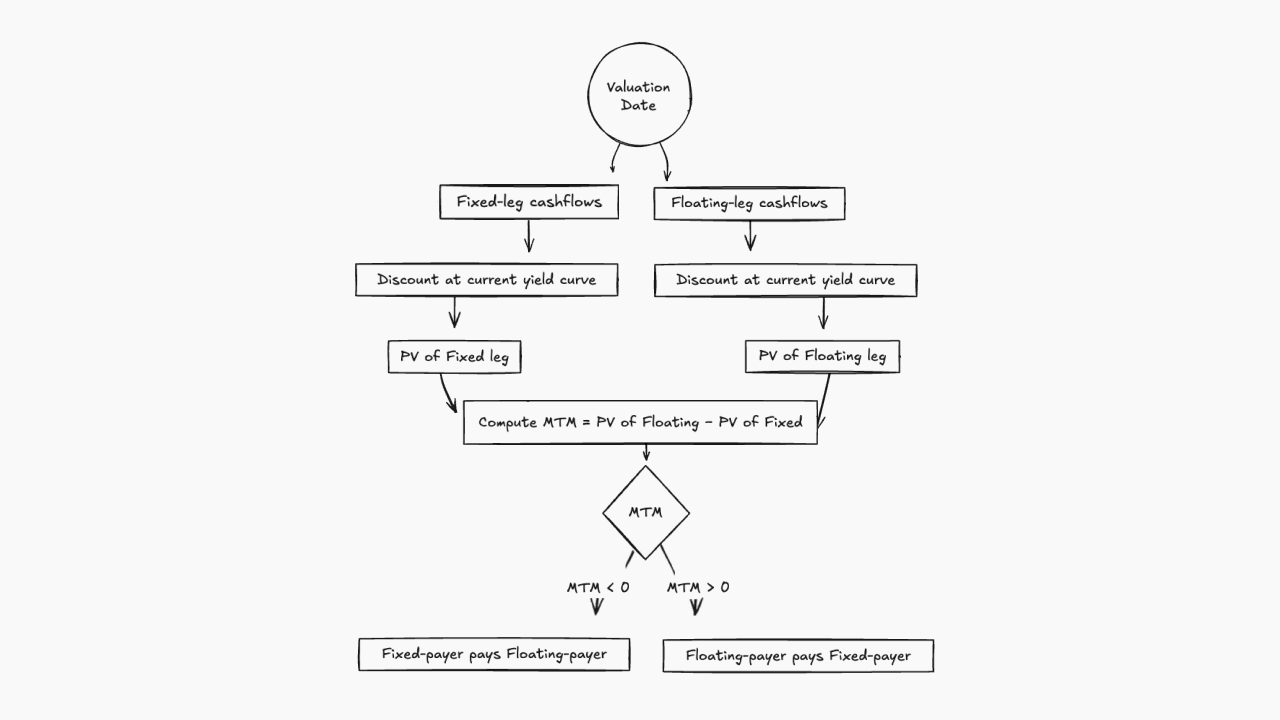
- A mark-to-market and accrued interest figure for each swap, at each reporting date, for the auditor
- An FX forward rate for equipment purchases or for modelling dividend distributions
The treasurer on another call described his requirement as "quite basic". He was right. It is basic, but getting the numbers right is non-negotiable.
Four problems project finance teams have with Bloomberg
1. One licence, a whole team of modellers
A Terminal licence belongs to one named user. In most finance teams we speak to, one or two people hold a licence, and the rest of the team does not have the data.
A licence for each modeller costs as much as the first one, so most teams do not buy them. The modellers wait for the person who has the data, and the curve in the model is updated less often than it should be. I saw this at first hand at a large solar developer before I started BlueGamma.
2. Amortising (amortizing) swaps in SWPM
Project finance debt amortises. The swap that hedges it amortises too, often with a construction period at the start. To get a swap rate for that profile on a terminal, someone sets up the swap, its notional schedule and its conventions in SWPM, Bloomberg's swap pricing screen.
The details matter more than people expect. A project finance adviser told us this year that if the curve interpolation is not right for an amortising profile, the swap rate can be 5 to 15 basis points off. Most modellers never check which interpolation their screen uses.
3. Download limits
Bloomberg's Excel add-in has daily and monthly data limits for each terminal (University of Pennsylvania library guide). A model with monthly periods over 25 years, across several facilities and currencies, pulls a lot of data points. If the terminal reaches its limit in the middle of a refresh, the data stops until the next period. We wrote about this in more detail in Bloomberg download limits.
4. Paying for a trading desk to use three functions
A terminal costs about $28,000 to $32,000 a year per user, according to Bloomberg's 2025 price letter as reported by NeuGroup. Our pricing guide has the detail. A project finance team uses perhaps three or maybe four of its functions. The cancellation is almost always a decision driven by a lack of fit. The need does not go away.
Within a year or two the company has closed two or three facilities, each with an interest rate swap attached. The year-end audit needs a fair value for every swap, and a clean versus dirty split if the company applies hedge accounting. The accountant needs a curve, and there is no terminal.
What a project finance team needs instead
The call was useful because the treasurer described his facilities in detail. They were typical for the sector.
Two facilities, two roll periods. A construction facility that rolls monthly, and a portfolio facility for the operating assets that rolls quarterly with amortisation. The models are usually monthly. So the team needs both the one-month and three-month curve for the same valuation date, fitted to the model's payment dates without losing accuracy.
A hedge to size before a larger financing. For a large financing, the useful number is a blended rate across the construction period swap and the operations period amortising swap. That is how the banks will price it at financial close. It gives a much better estimate of the debt cost than an average-life approximation. We explain the method in swap rate calculation in project finance. If the hedge has to be agreed before financial close, the same numbers feed a deal contingent hedge.
FX forwards for procurement. The company has no foreign entities, so there is no translation exposure. It buys equipment priced in US dollars and needs a forward rate for a specific delivery date, to estimate the cost to hedge.
Nothing in this list needs a terminal. All of it needs the data to be correct and available to every modeller, whether they work from home, the office or abroad.
What BlueGamma does for modellers
BlueGamma is an interest rate data and modelling tool, built for the person who builds the model. In practice that means:
- A swap pricer that takes an amortisation schedule. Upload or type the exact notional schedule and get the live mid swap rate for that profile. This is the SWPM job for project finance debt. Swap pricer
- A curve builder that matches your model. Choose the valuation date, the curve start date, the floating rate index and your model's period (monthly, quarterly or semi-annual), and download a curve that lines up with your payment dates. Forward curves
- No download limits. Refresh the whole model as often as you need, in the app, in Excel or through the API. Excel add-in · API
- Live pricing. Market data updates every 30 seconds, so the swap rate you quote in a credit paper is today's swap rate.
- A login for each person on the team. Nobody waits for the colleague who holds the licence.
- Your data in your AI assistant. Through our MCP server, you can connect BlueGamma to an AI assistant that supports MCP, such as Claude or ChatGPT. Ask it to update rate inputs in a model, check a swap rate against your term sheet, or build a short market note or presentation slide using real curve data instead of numbers the assistant guessed. Teams use it to automate the rate inputs they used to copy from a terminal by hand, and to produce client market updates.
Bloomberg or BlueGamma: the trade-off
| Bloomberg Terminal | BlueGamma | |
|---|---|---|
| Built for | Traders and investment teams across all asset classes | Modellers and valuation teams working with interest rates and FX |
| Who can use it | The named user on each licence | Each person on the team has a login |
| Forward curves for a valuation date | Yes | Yes, fitted to your model's period and payment dates |
| Amortising swap rate | SWPM, on the terminal | Swap pricer with an amortisation schedule |
| Downloads into Excel | Daily and monthly data limits | No download limits |
| Data updates | Real time | Every 30 seconds |
| News, equities, chat, trade execution | Yes | No |
| Typical cost | About $28,000 to $32,000 a year per user | Per seat (pricing) |
If you trade, or you need news and other asset classes, keep Bloomberg. Many of our customers keep one terminal for that and use BlueGamma for the models. If your team mostly builds models and values swaps, you pay for a lot of the terminal that you do not use.
Do you need a replacement?
You need one if you will model levered returns in the next year, or if more than one person in the business uses rates or FX data. If your company is a renewables developer, IPP or infrastructure fund and you have cancelled Bloomberg or are thinking about it, ask these two questions:
- Will you model levered returns on your projects in the coming year?
- Does more than one person in the business use rates or FX data? (If it is just one person, you can probably ask a friendly bank.)
If the answer to either is yes, you need a curve source. The sensitivity is not small. On today's USD SOFR curve, each 0.01% move in the swap rate on a 10-year $100m facility changes its value by roughly $80,000 on a bullet profile, or about $45,000 on an amortising profile. A 0.25% move is $1m to $2m. Nobody wants to explain to an investment committee or an auditor that a number of that size came from a curve someone downloaded three weeks ago.
Try it on your own facilities
BlueGamma provides the forward curves, swap pricing and swap valuations that a project finance team used to take from Bloomberg, without the rest of the terminal, and with a login for each person.
The treasurer's closing comment on the platform was short: "When we trialled it, it looked very intuitive and well designed." That is the standard we work to. If it gets complicated, something has gone wrong.
Start a free 14-day trial, no card required, or book a call. For the live curves, see the SOFR forward curve and the EURIBOR forward curve.
Bloomberg is a trademark of Bloomberg Finance L.P. BlueGamma is not affiliated with, endorsed by, or sponsored by Bloomberg. Customer quotes are reproduced with the customer's knowledge and reflect their own opinion.
Frequently Asked Questions
We cancelled Bloomberg. Where can we get interest rate curves to value our swaps?
You need forward and discount curves for each index your swaps reference, on each valuation date. BlueGamma provides forward curves across 30+ currencies, including SOFR, SONIA and EURIBOR, for any past or current date. The mark-to-market for each swap sits in the same place, so the audit figures come from one documented source. See our methodology.
Can I get forward curves in Excel without a Bloomberg terminal?
Yes. The BlueGamma Excel add-in pulls forward curves, swap rates and FX forwards straight into your model, with no download limits. You can also download a curve from the app, already fitted to your model's period, or use our guide to pulling a forward curve into Excel.
How do I price an amortising (amortizing) swap without SWPM?
Use a swap pricer that accepts a notional schedule. In BlueGamma's swap pricer you enter the amortisation profile, the dates and the conventions. It returns the swap rate for that exact profile. For project finance debt with a construction period, price the blended rate across both periods, as the banks will at financial close.
Can we value our swaps for the year-end audit without Bloomberg?
Yes. For each swap you need the mark-to-market on the reporting date, from a curve the auditor can trace to a named source. In the BlueGamma MtM calculator you set up each swap once, including amortising swaps, and get a monthly mark-to-market, the PV01 and a valuation report you can download. Past valuation dates are available too. If you want to check the method, we show a mark-to-market calculation with a worked example.
Is there a limit on how much data we can download?
Not with BlueGamma. There are no download limits in the app, the Excel add-in or the API. You can refresh a full monthly model across several facilities and currencies as often as you need. Bloomberg's Excel add-in has data limits, which is one reason teams look for an alternative.
Can I use interest rate data in ChatGPT or Claude?
Yes, if the assistant supports MCP (Model Context Protocol). Connect the BlueGamma MCP server and the assistant can fetch live swap rates, forward curves and FX forwards when it answers you. A market note, model update or slide then uses real market data, not a number the assistant made up.
.png)