Capital Asset Pricing Model (CAPM) Calculator: Calculate Cost of Equity
Use our Capital Asset Pricing Model (CAPM) calculator to find the Cost of Equity.
Our CAPM Calculator factors in Country Risk and uses Live rates from +100 countries.
CAPM Inputs
Using United States's risk-free rate
Sign up to view real-time rates
CDS-based total ERP (includes country risk)
β = 1.0 means the asset moves with the market
ERP data powered by Aswath Damodaran
Explore our platform
See where rates are heading with forward curves for SOFR, SONIA, and 25+ benchmarks — ideal for financial modelling.
Look up historical compounded rates like SOFR, SONIA, and €STR to check quarter-end values or review how rates have moved over time.
View real-time and historical swap rates across 20+ currencies to benchmark funding costs and compare markets side by side.
Bring live RFR and swap data straight into your models using our Excel Add-in or REST API — no manual downloads needed.
With our intuitive calculator, you can simplify the mark-to-market (MTM) valuation of your swap portfolio to monitor current positions and analyse historical performance.
Our platform lets you aggregate all your essential data into a simple, personalised dashboard to visualise financial data and track key performance indicators.
trusted by















FAQs
The Capital Asset Pricing Model is a formula used to calculate the minimum return an investment must generate to justify its risk. It is primarily used to determine the Cost of Equity, helping businesses set hurdle rates for new projects and investors estimate the fair value of a stock or asset.
The theory behind CAPM rests on a simple principle: investors require two types of compensation for the Systematic and Non-Diversifiable risk that they take when investing in an asset:
- Compensation for Time (Risk-Free Rate): The return you would get for placing money in a guaranteed investment, like a US Government Bond. This accounts for the time value of money.
- Compensation for Risk (Risk Premium): The extra return required for taking on the volatility of the stock market.
CAPM theory creates a distinction between two types of risk:
- Unsystematic Risk (Diversifiable): Risks specific to a single company (e.g., a CEO scandal or a factory fire). CAPM assumes investors can eliminate this risk by holding a diversified portfolio, so it does not calculate a reward for it.
- Systematic Risk (Non-Diversifiable): Market-wide risks like inflation, wars, or recessions. This risk cannot be diversified away. CAPM is designed specifically to price this risk.
Ultimately, the model serves as a valuation benchmark: if an asset's independent expected rate of return is above the calculated Cost of Equity, it is deemed a potentially undervalued investment proposition (a good buy), whereas if it falls below, it is considered overvalued (a poor investment).
Below you will find the factors that CAPM uses to compensate an investor for their investment risk.
CME Group Benchmark Administration Limited administers the rates, which are then published by the Chicago Mercantile Exchange (CME).
Rf - (Risk-Free Rate): The current yield on the 10-Year Government Bond for the selected country (e.g., US Treasury).
Β - (Beta): A measure of the asset's volatility relative to the overall market.
β = 1.0 : Moves exactly in line with the market.
β > 1.0 : Aggressive. If the market goes up 10%, this stock might go up 15%.
β < 1.0 : Defensive. If the market crashes, this asset falls less than average.
ERP = (ERPmature + CRP) - (Equity Risk Premium): The total equity risk premium. This includes the mature market premium plus the country-specific risk premium.
Ke - (Cost of Equity) It represents the minimum rate of return an investor requires to justify taking the risk of a specific investment.
For international valuations, accurate risk assessment is critical. We offer two methods for calculating the Total Equity Risk Premium (ERP):
1. CDS-Based (Market Responsive)
- How it works: Uses Credit Default Swap (CDS) spreads to calculate the country risk component.
- Best for: Real-time analysis. This method is more responsive to current market conditions and volatility.
2. Rating-Based (Stability Focused)
- How it works: Uses Moody's sovereign credit ratings to derive the country risk component.
- Best for: Long-term modeling. This method is more stable but updated less frequently than CDS spreads.
Here’s a CAPM Calculation Example to demonstrate how it works:
Risk-Free Rate (Rf) = 4.30% (United States 10Y Govt Bond)
Beta (β) = 0.50
Equity Risk Premium (ERP) 4.69% = 4.23% (base) + 0.46% (country risk - CDS spread)
β × ERP = 2.35%
Ke (Cost of Equity) = 4.30%+2.35%=6.65%
Here’s a quick CAPM Formula Explainer from the Khan Academy
To get a better insight, the graph below displays the visual representation of the CAPM equation, officially called the Security Market Line (SML). It acts as a map to help investors determine if a stock is giving them a "fair deal" based on how risky it is.
Here is how to read the chart and why it is useful:
- The Security Market "Fair Value" Line (SML): The diagonal blue line represents the perfect balance. It starts at the Risk-Free Rate (safe money) and rises upward. The higher the risk (Beta) on the bottom axis, the higher the expected return should be on the vertical axis. It’s derived directly from the CAPM formula, which calculates the expected rate of return (the Y-axis) as a function of the asset's systematic risk or Beta (the X-axis)
- The Market Benchmark: The blue dot shows the market average (where Beta = 1). This is the standard aimed for by the general economy. For the US market, the S&P 500 is the standard default used by almost everyone as the proxy for the "Market Benchmark.
- 🟢 The "Bargain" (Undervalued): The green dot sits above the line. This stock is generating higher returns than its risk level suggests it should. In CAPM theory, this is a clear "Buy" signal.
- 🔴 The "Bad Deal" (Overvalued): The red dot sits below the line. This stock is risky, but it isn't paying you enough reward to justify that risk. CAPM suggests you should avoid or sell this asset.
1. Stock Valuation (DCF Analysis)
The Cost of Equity is the discount rate used to value a company’s future cash flows. It allows analysts to calculate the Net Present Value (NPV) of a stock to determine if it is undervalued or overvalued.
2. Calculating WACC
Cost of Equity is a vital component of the Weighted Average Cost of Capital (WACC). While interest rates determine the cost of debt, CAPM determines the cost of equity. Together, they define the total cost of funding for a business.
3. Project "Hurdle Rates"
Before launching a new project or factory, companies calculate a hurdle rate. If a project's projected Return on Investment (ROI) is lower than the Cost of Equity, the project will destroy shareholder value and should be rejected.
4. Performance Measurement (EVA)
Economic Value Added (EVA) measures true profitability. A company is only truly profitable if its operating profit exceeds the cost of the capital used to generate it—specifically the Cost of Equity.
Other Calculators
RFR Calculator
Calculate RFR-based interest across 20+ currencies with full support for global indices including SOFR (USD), SONIA (GBP), and €STR (EUR).
Cap Calculator
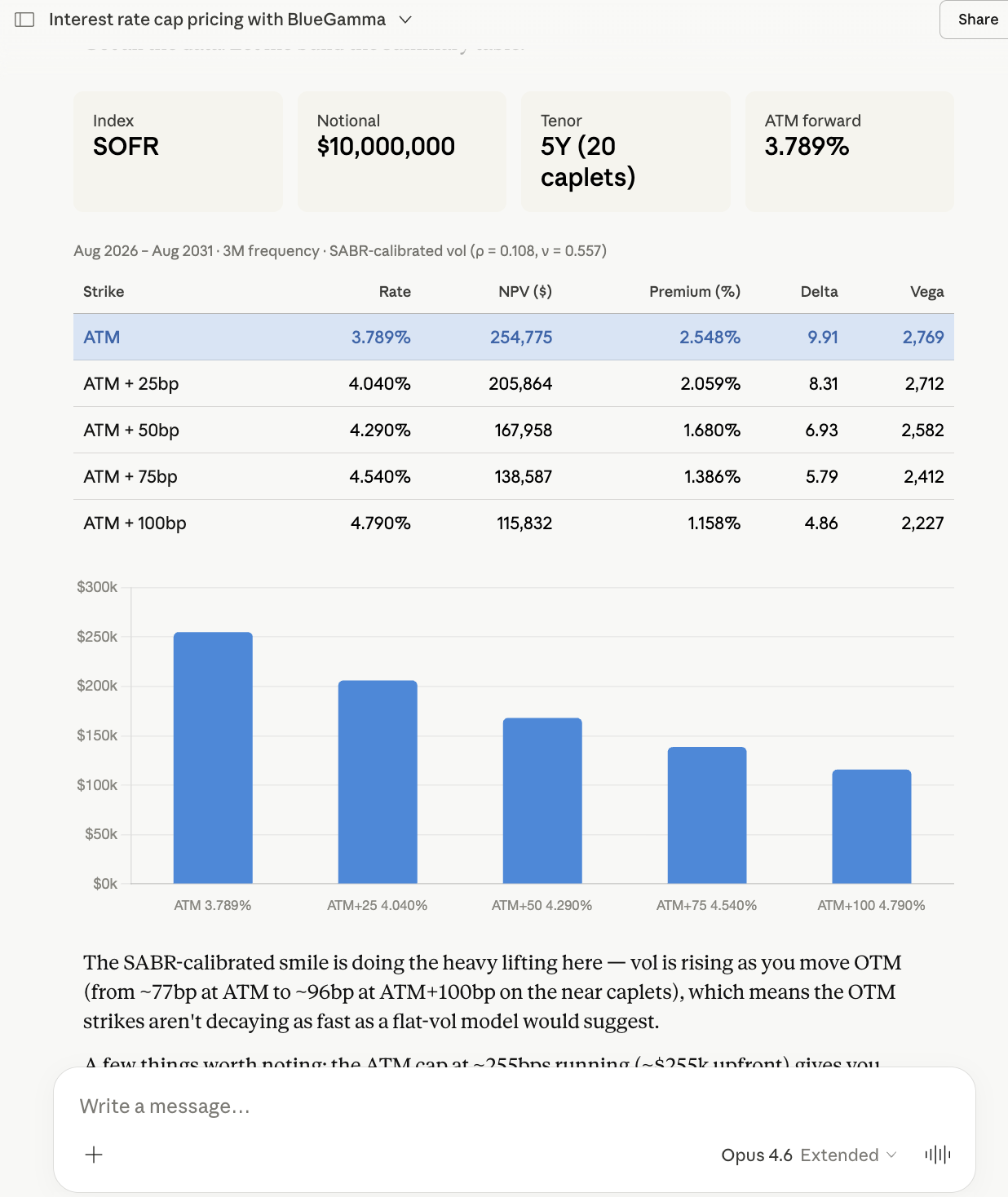
Price an interest rate cap instantly. Compare cap costs across tenors and strikes for SOFR, SONIA, EURIBOR and 30+ indices.
Defeasance Calculator
Estimate defeasance costs in seconds with our free CMBS calculator. View treasury bond requirements, total costs, and savings vs. yield maintenance.
Yield Maintenance Calculator
Calculate your yield maintenance penalty in seconds with live Treasury rates and detailed loan breakdowns.
