How to Build a SOFR Forward Curve with the BlueGamma API Using Python

Ready to integrate forward curves directly into your workflows? This guide will show you how to fetch forward rates using Python and the BlueGamma API.
Step 1: Set Up Your Environment
Before we begin, ensure that you have Python installed along with the requests and matplotlib libraries. If you don't have them yet, install them using:
pip install requests matplotlib
Step 2: Fetch SOFR Forward Rates
The /forward_rate endpoint in the BlueGamma API lets you fetch forward rates for specific start dates and tenors. Let's start with an example for a single date:
import requests

# API endpoint
url = "https://api.bluegamma.io/v1/forward_rate"

# Query parameters for a single forward rate
querystring = {
    "index": "SOFR",            # Reference rate
    "start_date": "2025-06-30", # Start date
    "end_date": "3M"            # Fixed tenor of 3M
}

# API headers (replace 'YOUR_API_KEY' with your actual API key)
headers = {"X-Api-Key": "YOUR_API_KEY"}

# Fetch the forward rate
response = requests.get(url, headers=headers, params=querystring)
if response.status_code == 200:
    data = response.json()
    print("Forward Rate:", data["forward_rate"])
else:
    print("Error:", response.status_code, response.text)
The script fetches the 3-month SOFR forward rate starting on 2025-06-30. The response includes the forward rate and other relevant details.
Step 3: Build a SOFR Forward Curve
Now, let's expand this to fetch forward rates for a set of pre-definded dates. By doing so, we'll plot a SOFR forward curve to visualise how the rate evolves over time.
import requests
import matplotlib.pyplot as plt

# API endpoint
url = "https://api.bluegamma.io/v1/forward_rate"

# Define predefined start dates (end of June and December each year)
start_dates = [
    "2025-06-30", "2025-12-31",
    "2026-06-30", "2026-12-31",
    "2027-06-30", "2027-12-31",
    "2028-06-30", "2028-12-31",
    "2029-06-30", "2029-12-31",
    "2030-06-30", "2030-12-31"
]

# Fixed tenor (3M)
tenor = "3M"
forward_rates = []  # To store forward rates

# API headers (replace 'YOUR_API_KEY' with your actual API key)
headers = {"X-Api-Key": "YOUR_API_KEY"}

# Fetch forward rates for each predefined start date
for start_date in start_dates:
    querystring = {
        "index": "SOFR",            # Reference rate
        "start_date": start_date,   # Start of forward period
        "end_date": tenor           # Fixed tenor of 3M
    }

    response = requests.get(url, headers=headers, params=querystring)
    if response.status_code == 200:
        data = response.json()
        forward_rates.append(data["forward_rate"])  # Append the forward rate
    else:
        print(f"Error fetching data for start date {start_date}: {response.status_code}")
        forward_rates.append(None)  # Add a placeholder for missing data

# Plot the 3M forward curve
plt.figure(figsize=(12, 6))
plt.plot(start_dates, forward_rates, marker='o', linestyle='-', color='blue', label='3M SOFR Curve')

# Customize the plot
plt.title('3M SOFR Forward Curve (2025-2030)', fontsize=16)
plt.xlabel('Start Date', fontsize=12)
plt.ylabel('Forward Rate (%)', fontsize=12)
plt.xticks(rotation=45)  # Rotate x-axis labels for readability
plt.grid(True, linestyle='--', alpha=0.7)
plt.legend(fontsize=10)
plt.tight_layout()

# Display the graph
plt.show()
Step 4: Understand the Output
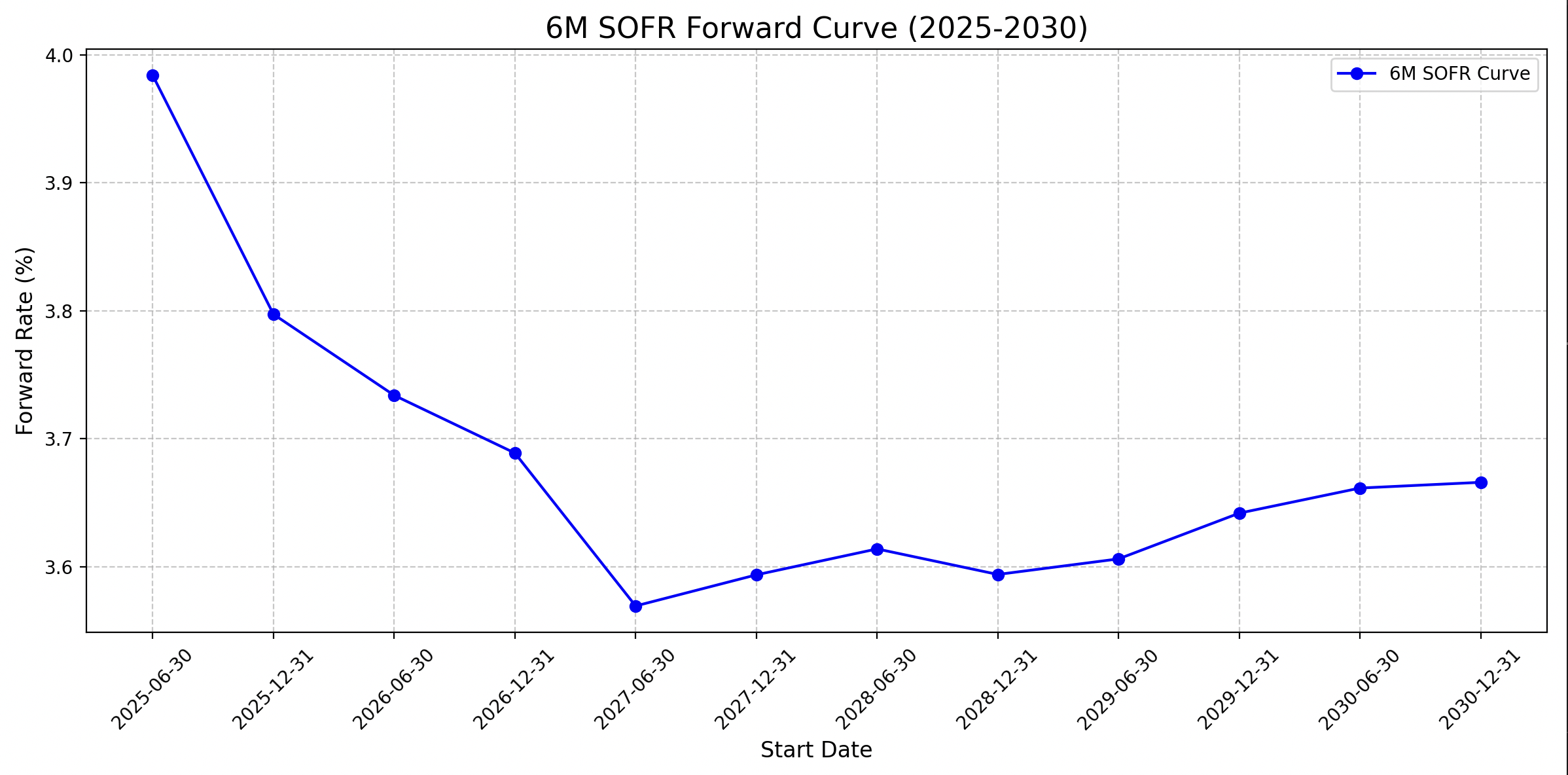
The graph plots the 6-month SOFR forward curve with:
- x axis: Predefined start dates
- y-axis: forward rates for 6M compounded SOFR
Try it Yourself!
Whether you're forecasting interest costs or performing valuations, the BlueGamma API makes it easy to fetch real-time swap rates and build forward curves. Request access to the API here.
Check out our other API tutorials on Euribor API and CORRA API.
.png)