
What Is a Swaption? Payer vs Receiver, Pricing and Examples

A swaption is an option to enter an interest rate swap at a pre-agreed fixed rate on a future date. The buyer pays a premium today for the right, but not the obligation, to become a payer or receiver of the fixed rate when the option expires. Treasury teams and fund managers use swaptions to lock in protection against rate moves that may or may not materialise: a planned refinancing, an acquisition that might not close, or a pension liability that needs hedging at the right level.
This guide explains how swaptions work, the difference between payer and receiver swaptions, what they cost, and how they are priced, using live market data and real trade prints rather than textbook numbers.
What is a swaption?
A swaption (a contraction of "swap option") gives the holder the right to enter an interest rate swap with a known fixed rate, the strike, at a future expiry date. Two dates define the structure: the option expiry and the tenor of the underlying swap. A "1Y×5Y" swaption (read "one-year into five-year") expires in one year and, if exercised, delivers a five-year swap starting on that date.
The buyer pays the premium upfront, usually quoted in basis points of the notional or as a percentage. The seller, typically a bank swap desk, keeps the premium whatever happens. Swaptions trade over the counter in an institutional market: on a single recent trading day, over 500 newly executed European swaptions across USD, EUR, GBP and other currencies were publicly reported under US swap reporting rules.
How does a swaption work?
A swaption works in three steps: the buyer pays a premium at trade date, waits until expiry, and then exercises only if the swap on offer is better than the market. Concretely:
- Trade date. Buyer and seller agree the structure (expiry, swap tenor, notional), the strike rate, and the premium. The premium is paid upfront.
- Expiry date. The holder compares the strike against the prevailing swap rate for the underlying tenor. If exercising is favourable, they exercise; if not, the option lapses and the premium is the total cost.
- Settlement. Exercise either delivers the actual swap (physical settlement) or pays out its cash value (cash settlement).
Exercise styles
Most swaptions are European: exercisable only on the expiry date. Bermudan swaptions can be exercised on a schedule of dates, typically each coupon date of the underlying swap, and are common inside cancellable structures (more on those below). American swaptions, exercisable any day, are rare in rates markets.
Cash vs physical settlement
Physically settled swaptions deliver a live swap that then runs to maturity. Cash-settled swaptions pay the mark-to-market value of that swap at expiry instead. USD swaptions are predominantly physically settled; the EUR market moved to a cash settlement convention based on the actual discounted swap value. Economically the two are designed to be equivalent at expiry.
What is the difference between a payer and a receiver swaption?
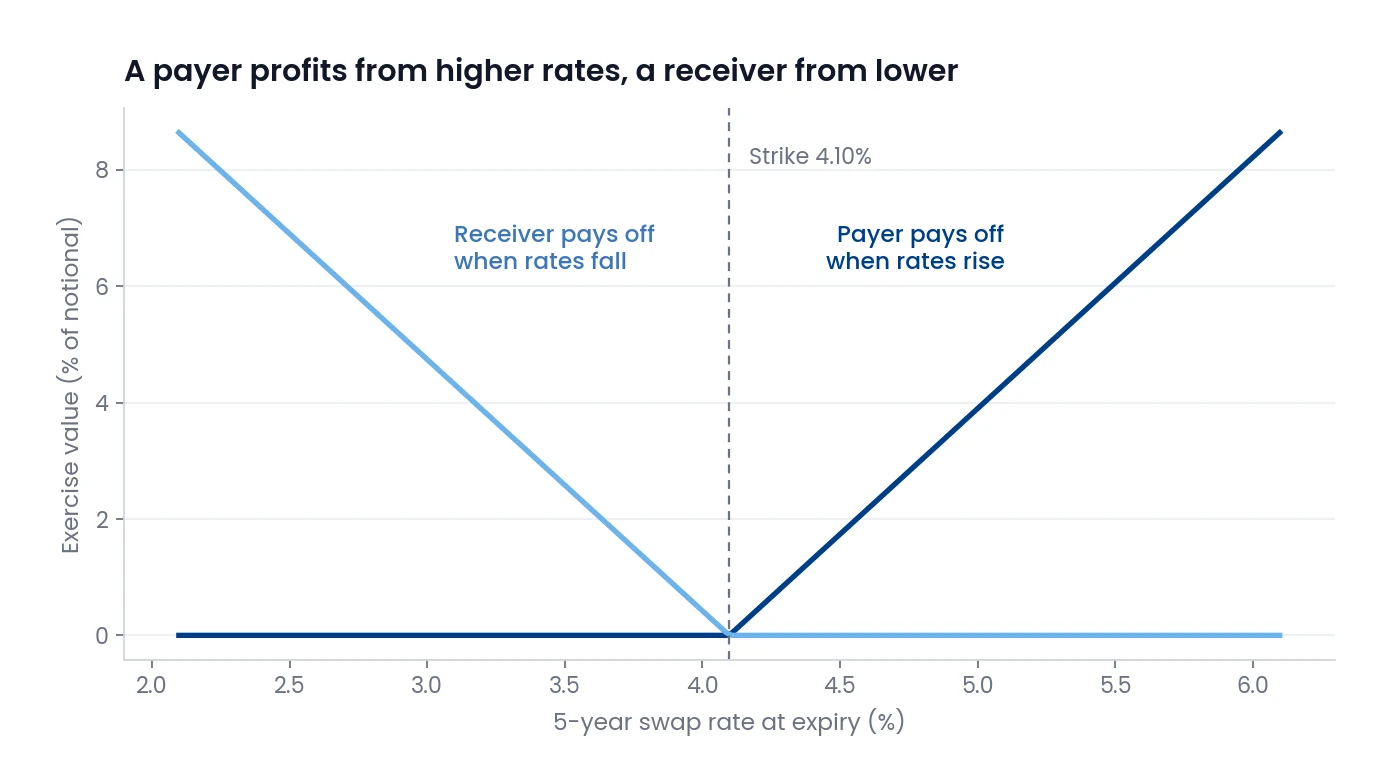
A payer swaption gives the right to pay fixed on the underlying swap, so it profits when rates rise above the strike. A receiver swaption gives the right to receive fixed, so it profits when rates fall below the strike. The premium is the most the buyer can lose in either case.
| Payer swaption | Receiver swaption | |
|---|---|---|
| Right to | Pay fixed, receive floating | Receive fixed, pay floating |
| Profits when | Swap rates rise above the strike | Swap rates fall below the strike |
| Typical holder | A borrower hedging future floating-rate debt | An investor or pension hedging reinvestment at lower rates |
| Equity analogy | Call on rates | Put on rates |
| Maximum loss | Premium paid | Premium paid |
A payer and a receiver bought together at the same strike make a straddle, a position that profits from a large move in either direction. Straddles are a meaningful share of interdealer swaption flow because they isolate volatility from direction.
What are swaptions used for?
Swaptions are used to hedge interest rate risk that is conditional: exposure that depends on a future event, a future decision, or a level being reached. Common uses:
- Pre-hedging a planned financing. A borrower expecting to refinance in a year can buy a payer swaption instead of locking a forward starting swap. If rates rise, the swaption caps the fixed rate at the strike; if rates fall, the borrower walks away and swaps at the lower market rate. The same logic covers the gap between mandate and financial close when pre-hedging in project finance.
- Deal-contingent hedging. In M&A and project finance, the financing need disappears if the deal does not close. Swaptions (and deal-contingent swaps) hedge the rate risk without leaving an orphaned swap if the transaction falls away.
- Pension and insurance hedging. Liability-driven investors buy receiver swaptions to protect funding ratios against falling long-term rates, choosing the strike at the level where the damage starts.
- Cancellable debt and prepayment risk. Loans with early-repayment flexibility, callable bonds and cancellable swaps all contain embedded swaptions, whether or not the borrower prices them that way.
- Expressing a rate view with defined risk. Unlike a swap, a bought swaption cannot lose more than the premium, which is why funds use swaptions to position for central bank cycles.
Swaptions sit alongside caps and collars in the optionality toolkit: a cap protects a floating rate period by period, while a payer swaption protects the fixed rate you will swap at on one future date. Our guide to interest rate hedging strategies compares the full set.
How much does a swaption cost?
An at-the-money swaption on a five-year swap typically costs between roughly 1% and 3.5% of notional upfront, depending mainly on the option expiry and the level of implied volatility. Here is an indicative example, priced off the live SOFR curve at a stated vol assumption:
| $10m 1Y×5Y SOFR payer swaption, struck at the money | |
|---|---|
| Forward 5Y swap rate (= strike) | 4.10% |
| Normal volatility (assumption) | 90bp per year |
| Annuity of the underlying swap | 4.32 |
| Premium | $155,000, or 1.55% of notional (155bp upfront) |
| Delta / DV01 / Vega | 0.50 / $2,160 per bp / $1,724 per vol bp |
A useful desk rule of thumb reproduces that number: for an at-the-money swaption under the normal model,
ATM premium ≈ 0.4 × normal vol × √expiry × annuity
Plugging in: 0.4 × 90bp × √1 × 4.32 ≈ 155bp. The forward rate and the annuity are observable from the swap curve. The volatility is not: it is the market's price for uncertainty, quoted on a surface by expiry and tenor. That is why two quotes for the same structure can differ meaningfully, and why the vol input deserves the most scrutiny. You can rerun this example with your own vol assumption in our free swaption calculator, or see the live quoted levels on the swaption volatility surface.
The vol decides the model price, but the number on a bank's term sheet also carries the bank's margin. In practice:
Whenever a client shares a bank's swaption quote, the first thing I check is whether the bank has quoted a mid price, or an all-in price that includes the bank's charges. Sometimes you can work out how much the bank is charging by checking the mid yourself, but best practice is to ask the bank for a mid price and an all-in price separately.
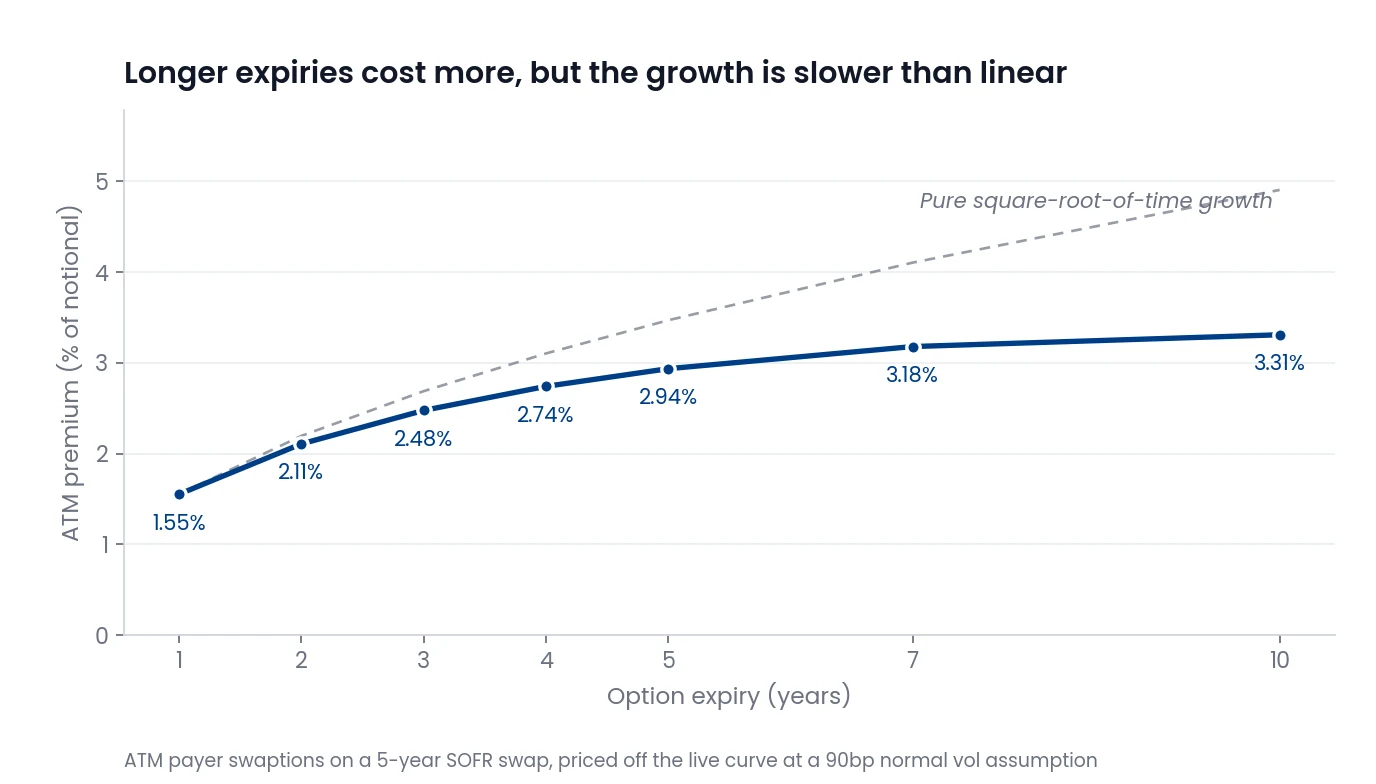
Two practical readings of that chart. First, doubling your protection window does not double the cost: a 2Y expiry costs 2.11% against 1.55% for 1Y. Second, read right to left it shows time decay, which is the cost of holding the option as expiry approaches.
How are swaptions priced?
Swaptions are priced with the Bachelier (normal) model in today's market. The model takes three inputs: the forward swap rate, the strike, and the normal volatility, and discounts the expected payoff over the underlying swap's annuity. The market moved from Black's lognormal model to the normal model when rates went to zero and below, because normal vol, quoted in basis points per year, behaves consistently at any rate level.
The forward swap rate is the rate at which the underlying swap could be locked today for that future start, derived from the same curve that prices overnight index swaps. The annuity converts each basis point of rate difference into present value. The volatility comes from the quoted surface: a grid of expiries against tenors, where each cell is the market's implied normal vol for that structure. Away from the money, desks also apply a skew, so out-of-the-money strikes carry different vols than the ATM level.
What are DV01 and vega on a swaption?
DV01 measures how much a swaption's value changes when the forward rate moves one basis point; vega measures the change for a one basis point move in implied volatility. In the live example above, the $10m payer gains about $2,160 for every basis point the forward rises, and about $1,724 for every basis point vol richens.
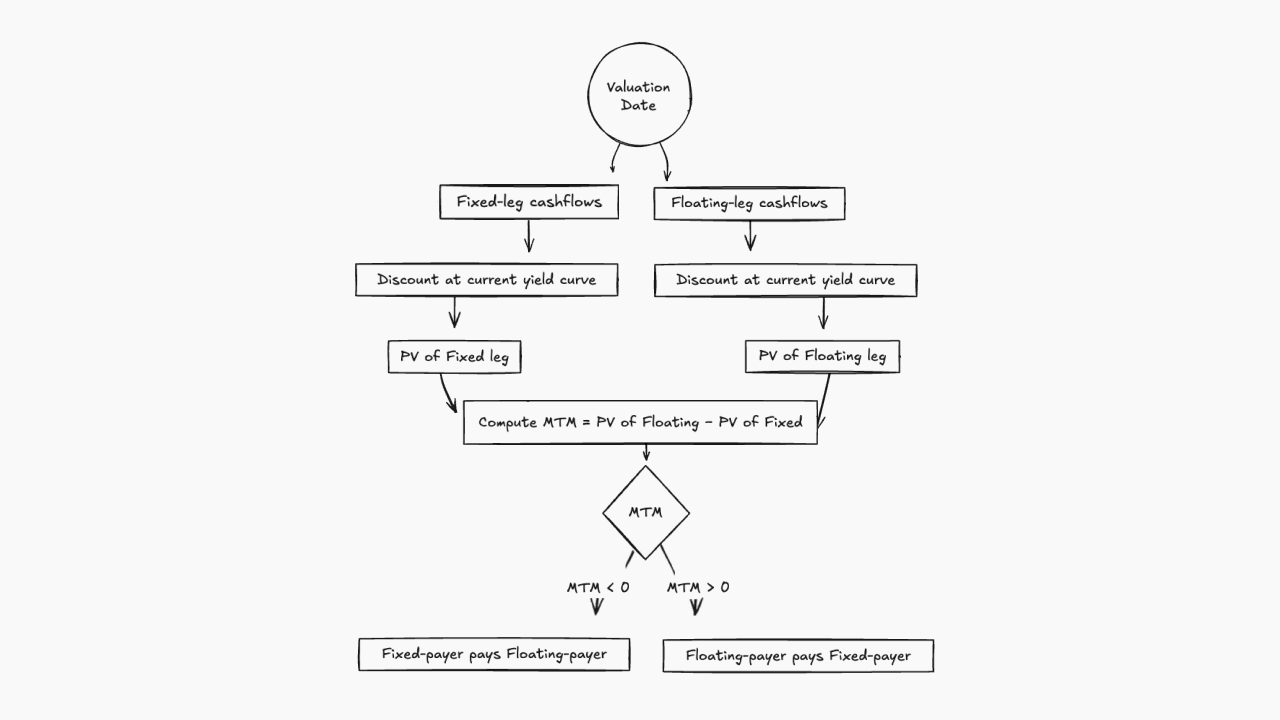
Delta ties the two markets together: an at-the-money swaption has a delta near 0.50, meaning it behaves like half the underlying swap. As rates rise through the strike, a payer's delta drifts towards 1 and it trades increasingly like the swap itself; as it falls out of the money, delta decays towards zero. That drift is why hedgers revalue swaption positions the same way they mark swaps to market, rather than setting and forgetting the premium.
Where do swaptions trade, and which structures are liquid?
Swaptions trade over the counter, between dealers and clients and on swap execution facilities, and US trades print to public swap data repositories under CFTC real-time reporting rules. That tape shows where the liquidity actually is:
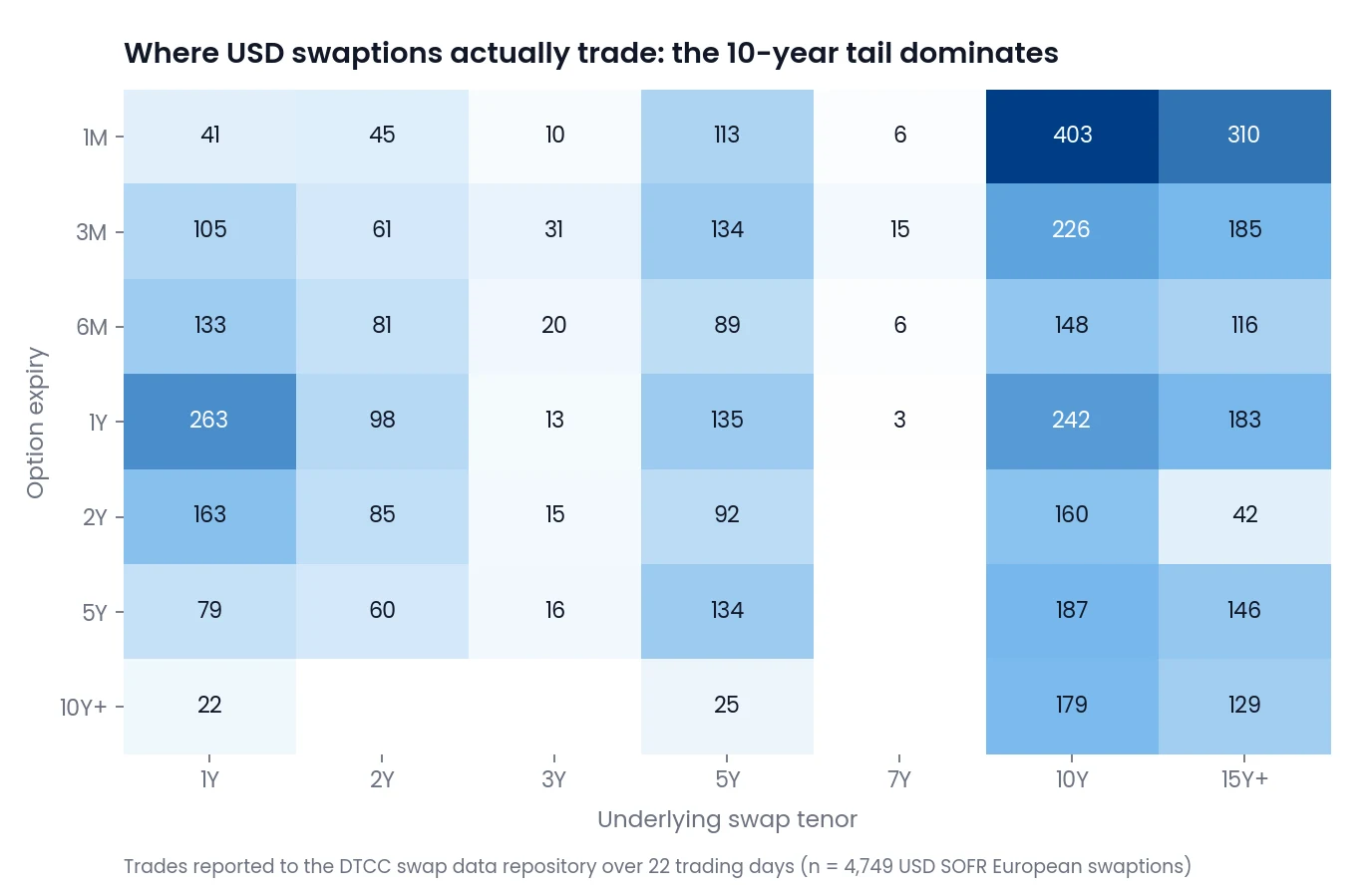
Averaged over a month of trading, the shape is clear: the 10Y underlying tenor takes roughly a third of all prints and tails of 10Y or longer take over half, while expiries cluster inside two years (about 80% of prints). The busiest single cell is the "vol triangle" corner of short expiry into the 10Y tail. Structures far from those points still trade, but quotes widen. Dealer notionals are large; blocks above regulatory cap sizes print with masked notionals.
What is a Bermudan swaption, and why do cancellable loans contain one?
A Bermudan swaption can be exercised on multiple dates rather than just one, and it is the option most borrowers have sold without ever seeing it priced. A cancellable swap, a swap the borrower may terminate early at no breakage cost, is economically a vanilla swap plus a sold Bermudan receiver swaption. The bank prices that optionality into the fixed rate; the borrower pays for it in a higher coupon whether or not they ever cancel.
The same embedded option appears in callable bonds and in fixed-rate loans with par prepayment rights. Multi-date exercise makes Bermudans harder to value than Europeans (they need a term-structure model rather than a single formula), which is precisely why the embedded version rarely comes itemised on a term sheet. Seeing the European swaption market's pricing for the nearest equivalent structure is one quick sanity check on what that flexibility might cost.
How can I price a swaption?
Three ways, in increasing order of precision:
- Rule of thumb. ATM premium ≈ 0.4 × normal vol × √expiry × annuity. Good for a sense check in a meeting.
- Free calculator. Our swaption calculator prices payer and receiver swaptions off the live curve with a vol assumption you control, in USD, GBP and EUR.
- Live surface. The BlueGamma portal, Excel Add-in and API price swaptions off the live quoted vol surface, with history across 20+ currencies. It ships with the 14-day free trial.
Pricing a 1Y×5Y SOFR payer through the API is one call:
import requests

API_KEY = "your_api_key_here"
BASE_URL = "https://api.bluegamma.io/v1"

response = requests.get(
    f"{BASE_URL}/swaption_price",
    headers={"x-api-key": API_KEY},
    params={
        "index": "SOFR",
        "start_date": "1Y",
        "maturity_date": "6Y",
        "swaption_type": "payer",
        "notional": 10_000_000,
    },
)
print(response.json())
The response returns the premium alongside the forward, strike, vol and risk sensitivities (values illustrative):
{
  "index": "SOFR",
  "currency": "USD",
  "swaption_type": "payer",
  "forward_rate": 4.10,
  "strike_rate": 4.10,
  "normal_volatility_bps": 90.0,
  "npv": 155000.00,
  "dv01": 2160.00,
  "vega": 1724.00
}
The full request and response schema is in the interactive API reference, with a step-by-step walkthrough in the swaption pricing guide. And the team is happy to walk through a live structure on a call.
All figures in this article are indicative mid-market levels, shown for information and education only. Nothing here is investment advice or a recommendation to enter into any transaction. BlueGamma is a data and analytics provider and is not authorised or regulated by the Financial Conduct Authority.
What is a swaption in simple terms?
A swaption is an option to enter an interest rate swap at a pre-agreed fixed rate on a future date. The buyer pays a premium upfront for the right, but not the obligation, to lock that rate later. If rates move in their favour they let the option lapse and deal at market instead; the premium is the most they can lose.
What is the difference between a payer and a receiver swaption?
A payer swaption gives the right to pay fixed on the underlying swap and profits when swap rates rise above the strike. A receiver swaption gives the right to receive fixed and profits when swap rates fall below the strike. Borrowers hedging future debt typically buy payers; pensions and investors hedging falling rates typically buy receivers.
How much does a swaption cost?
An at-the-money swaption on a five-year swap typically costs between roughly 1% and 3.5% of notional upfront, rising with the option expiry and the level of implied volatility. A quick estimate for an at-the-money structure is 0.4 × normal vol × the square root of the expiry in years × the annuity of the underlying swap.
How is swaption volatility quoted?
Swaption volatility is quoted as normal (Bachelier) volatility in basis points per year, on a surface arranged by option expiry and underlying swap tenor. A quote of 90bp means the market prices the forward swap rate to move about 90 basis points over a year, one standard deviation. Normal vol replaced lognormal Black vol as the market standard when rates went to zero and below.
What is a Bermudan swaption?
A Bermudan swaption can be exercised on several scheduled dates rather than only at expiry, usually each coupon date of the underlying swap. Bermudans are most often met in embedded form: a cancellable swap or loan is economically a vanilla swap plus a sold Bermudan receiver swaption, and the borrower pays for that optionality in the fixed rate.
Are swaptions cash or physically settled?
Both conventions exist. Physical settlement delivers the actual swap at exercise, which then runs to maturity; cash settlement pays the swap's mark-to-market value at expiry instead. USD swaptions are predominantly physically settled, while the EUR market uses a cash settlement convention based on the discounted value of the delivered swap.
.png)